The Legend of Zelda: Skyward Sword – Critical Miss #33

Flying High, Falling Fast

I’ve said before that I’m a more casual fan of the Legend of Zelda series. I’ve liked every game I’ve played from the illustrious series, but they are not in my favorite games of all time. However, I do want to play through all games in the series, though, both the good and the bad. That brings us to Skyward Sword. Released for the Wii in 2011, this is one of the most divisive games under Zelda’s name. The contrarian in me went into the game wanting to love it. While there are a lot of good things in it, the game has a counter to everything there is to like. This is one of the most mixed experiences I’ve had with a game in a long time.

One of the best aspects of Skyward Sword is the art style. It is bright, colorful, but not super cartoony. It’s like a good mix of the more realistic proportions of Ocarina of Time or Majora’s Mask and the colors and cell-shading of Wind Waker; it fits a Zelda game perfectly. The characters in the game are all bold, goofy, and memorable. Their charm instantly made me more interested and care about them, especially Zelda and Link themselves. Never before has their relationship been so fleshed out. They are best friends with some romantic feeling growing inside them. It gives Link a more personal reason for risking his life to save Zelda and gives the player strong context for the adventure. The character Grouse even has a nice character arc throughout the game, starting as a mere high school bully and turning into an honorable fellow trying to help Link however he can. The world of Skyward Sword is a pleasant and beautiful one to exist in, but it would be nice if there were more things to do in it.

A thick layer of clouds separates the two parts of Skyward Sword’s world: the surface and the sky. The surface is divided into the Faron Woods, Lanayru Desert, and Eldin Volcano. These are the areas where you will spend most of your time looking for and exploring dungeons, but in between dungeons you will have to return to the sky. To put it bluntly, the sky is too big, too empty, and traveling across it feels way too slow. Since you can see everything in the distance, travelling to a destination is a matter of pointing your bird at it and watching it sluggishly get closer. The first few times I flew in the game, it felt exhilarating until I realized how little nuisance is needed to control your Loftwing. Besides Goddess Chests that appear in the sky, there’s nothing to find in it. There are only a few memorable islands worth exploring in the sea of cloud including Skyloft, the main hub, the rest are just floating rocks that neither pique interest or act as an obstacle to avoid.

So flying above the clouds is not terribly engaging or fun, but what about below them?  Since there are only three main areas you will explore below the clouds, the world of Skyward Sword feels rather small, especially since you will revisit these areas at least three times each. Areas sometimes change, like the Faron Woods being flooded at a point, or there will be all new areas to explore for a dungeon entrance, but it doesn’t help the game world feel any less small or tedious. Often to find a dungeon, you will have to use Fi’s dowsing abilities to find things. This process gets very tiresome and repetitive after the first few times. Same with the strange stealth sections when doing a Goddess Challenge to get a new piece of equipment. There are even times the game makes you run through the entirety of a section you’ve already played in order to progress—most egregious of this would be the 3rd trip to Eldin Volcano where you lose all your items and have to sneak around enemies to get them back. Once you get through all the tedium and nonsense and actually get inside a dungeon, though, is when the level design of Skyward Sword starts to shine.

Dungeons are always a highlight of any Zelda game because they blend the gameplay loops of exploration, puzzle solving, and combat. Skyward Sword is no different since the dungeons are probably the best part of the game. Each has unique gimmicks and different visuals, despite taking place in similar areas. From using special stones to shift time in certain areas, lowering and raising a central statue, and dropping water in lava to create platforms, all the dungeons offer something new and interesting to play with. These are probably the most balanced dungeons in series too, with puzzles being tricky and clever, but never too obtuse to feel unfair. The loop of finding a new item in a dungeon, discovering ways that new tool opens new paths and lead to the boss, and using the item against that boss is as strong as ever. The bosses themselves are also a blast. Blowing sand away to reveal Moldarach, pulling the arms off of Koloktos to use its own weapons against it, and pushing Scaldera down a ramp to weaken it; every boss is interesting and fun to fight. That is, when the game is not reusing bosses, which it does a lot. Ghirahim and Demise will both have to be fought multiple times throughout the game. While Demise is always a pretty lame fight, Ghirahim has the nugget of a great fight in him, but it hindered by the games controls.

Being released on the Nintendo Wii, Skyward Sword makes heavy use of motion controls. This is why opinions on the game are so mixed amongst Zelda fans. I played the recent HD remaster on the Switch where it can be played without these motion controls. Instead of waving your arm for a sword slash, you just flick the right stick; instead of thrusting the nunchuck forward, you click in the left stick for a shield parry; and instead of aiming the bow or slingshot with the pointer, the right stick is again used. These controls work about as well as they can, but they still feel unresponsive and clunky. This is especially true when using or selecting items, where the difference between clicking the right trigger and holding it down is seemingly a matter of microseconds, causing the item selection wheel to pop up in the heat of battle when you were trying to aim your bow at an enemy. These controls have a trickle-down effect on the rest of the game, adding to the sense of tedium and clunkiness that is present throughout, but especially in combat.

Much like flying around the overworld, combat in Skyward Sword is something that starts off feeling thrilling until fatigue quickly sets in. Since you can attack in eight directions at any time, you have more freedom than in any other Zelda game. Enemies will block your attacks and this encourages you to feign to create openings to hit them. This helps every enemy encounter feel unique, challenging, and engaging since you are not just waiting for an opening and spamming the attack button. That would be great if spamming the attack button wasn’t more often than not the easiest way to break an enemy’s guard. Even Ghirahim, whose whole deal is he will grab your sword if you don’t feign attacks, goes down pretty easily if you just spam sword swings in different directions. It is a shame because I can see what the developers were trying to do, to make every fight require attention and skill and patience to beat, but it’s not fleshed out enough, the enemy AI not smart enough, and the controls not refined enough to require players to get good at it to survive. I probably died more times in Skyward Sword than any other Zelda game, but it always felt like the result of poor controls rather than any lack of skill.

Like I said at the beginning, playing through Skyward Sword is the most mixed experience I’ve had with a game in a long time. I didn’t hate the game, there is a lot of fun that can be found in it, but for everything good the game has, there is something negative that hampers it. It was ambitious to make a game that relies almost entirely on motion controls, but I can see a more enjoyable game buried here that would be alright if it had standard Zelda controls and mechanics. Even that wouldn’t have fixed everything with the game though. The world design and progression throughout the game is just tedious and slow and extremely bloated. The search for the Goddess Flames or the Triforce, could have easily been cut and the game wouldn’t have lost anything important. But I still had fun during parts of the game. Skyward Sword is still a Zelda game and still rather good as far as AAA games go, but it is the Zelda game that I have the least interest in revisiting anytime in the future. I played through it once and that’s enough for me. 

The Binding of Isaac & Forever Games

The Binding of Isaac is my favorite game and I’ve been playing way too much of it lately. Since the final expansion, Repentance, released on consoles last week, the game has its hooks firmly in me again after months of not really touching it. There are a few games I experience this waxing and waning of interest with: Stardew Valley, the Monster Hunter and Pokémon series, Darkest Dungeon—all games I will have a feverish urge to play all of suddenly, games I will obsessively play for a few weeks, and not have to desire to touch again for months until the cycle repeats. I call these types of games “Forever Games” and Isaac is my ride-or-die forever game.

No game is meant to last forever, though, so how can a game be considered a forever game? I define this type of game not as a game that will take up 100% of your free time and be the only thing you play for the rest of your life, but more so a game you can pick up, play, out down, and return to at any time and still enjoy as much as always. I often think about what would happen if I ever had to get rid of my game collection, to pare it down to just a few titles and have only them to play going forward. Although I have lots of games—probably too many games—on my shelf and digitally to play, I feel like I could easily just choose three to five games in my collection to last me forever. And I honestly think that anyone who plays video games could do the same. They may be massive strategy games, MOBAs or MMOs, multiplayer shooters, or giant open world games. These games, the ones that someone could look at and say “I could be happy just playing this for the rest of my life if I had to,” these are forever games to me.

There is another term that is similar to mine of the forever game: the desert island game. You might be asking what the difference between a forever game and desert island game is and the answer is delicate. I don’t much like the term desert island game. It strikes me as more of a thought experiment or game you discuss with your friends. Choosing a game that you would want to be stranded on an island with as opposed to a game you could see yourself enjoying playing at any time is a subtle but important difference. I might choose a game like Skyrim, a game I would want to force myself to make the time to play, for a desert island game; I might choose a big game that would take forever to 100% like Super Mario Odyssey or Breath of the Wild; or I might choose some sort of fighting or strategy game so I have the time to dig deep and learn it inside out. Choosing a game with the expectation of forced isolation is less personal than choosing a game you have already played and know for certain you would be happy playing for the rest of your life. And that brings me back to The Binding of Isaac.

I can’t recall how I first learned of Isaac. It might have been from an old Super Beard Bros video or just a random top 10 YouTube video. I do remember the hours and hours I’ve poured into the game since first playing it in 2015. I put 200-300 hours in on my 3DS, 200+ hours so far on my Switch, and countless hours (I would estimate at least another 200) on my PS4. Isaac has been with me for half a decade and has shaped the gamer I am today; it helped me through some of my worst bouts of depression; and helped me discover my favorite YouTuber: Northernlion—which is obvious if you are familiar with the man’s content. But this is all to say that I love Isaac; obviously, it is my forever game. Now let’s answer why that is.

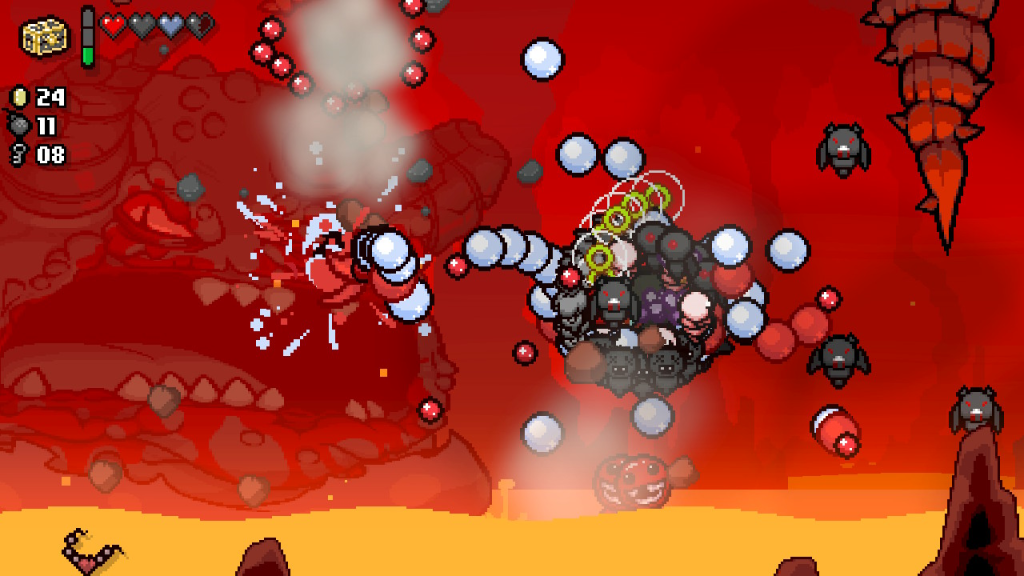
Isaac is a roguelike, meaning each time you boot it up the rooms, items, bosses, everything is randomly generated. Death ends a run and you start completely fresh when dropping back into the basement for a new one. This is all standard roguelike stuff, but what sets Isaac apart in my mind are the synergies. With hundreds of items, all combining and interacting with each other in strange, powerful, or run-ruining ways, each run feels more different in Isaac than any other roguelike I’ve played. More entertaining too. Besides discovering new combinations or building different archetypes of runs, the visual spectacle of wacky synergies is always a blast to watch. Isaac is an endlessly replayable game. Not just due to the randomly generated runs and seemingly infinite ways the items interact with each other, but because it is just absolutely massive.

There is just a shit ton of content in the Binding of Isaac. 34 different characters to play as, different routes to take and end bosses to fight, 45 special challenge runs to beat, and over 600 secrets to unlock that give you new items, trinkets, and consumables to play with in the game. If you only unlocked one new thing in The Binding of Isaac a day, it would take at least a few years to get everything. I’ve been playing the game off and on for over five years and I still have never gotten a 100% completed save file—although, this is mainly due to moving what console I primarily play it on. There are hundreds of hours to juice out of Isaac just to get a 100% save file and after that, you can just keep playing it since every run is different and fun. And the best part about this is that it feels like a complete game. There are no pay-to-win mechanics, no option to just purchase a deluxe edition with everything unlocked, no road map or any of the live service bullshit that seems to fill half of the AAA games releasing now. While those types of games feel soulless, cynical, and greedy, Isaac still feels nurtured, personal, and true to its designer, Edmund McMillen.

Even a game as story light as Isaac needs context for the world it brings the player into. It needs themes for the players to reflect on. The Binding of Isaac deals in themes of Catholic guilt, dysfunctional families, religion zealotism, and child abuse. McMillen uses the game to explore these themes as they affect his upbringing, his current life, and the world at large; and they very thematically resonate to me. Through playing Isaac, I found myself looking back on my own Catholic upbringing and family life as a kid, not only the bad, but also the good. It helped me accept how those things molded me into the person I am today. It helped me see religion as a whole in a less black-and-white way than I used to; helped me see the community some people find in their religion and the good it can do.

This connection with the themes, this interest in Catholic myths and demons the game fostered in me, is a huge reason why I continue coming back to Isaac again and again and again. Add to that, the replayable nature of the game and mountain of things to unlock, characters to play as, and synergies to learn, and the game never gets stale. It is the game I boot up when I just need to kill an hour or two. It is the game I turn on when I have no interest or am too depressed to play any of the other games on my shelf. It is the game I can also rely on to destress or calm me down when I’m feeling too anxious. With the release of Repentance on consoles, I am determined now to finally buckle down and 100% the game. It might take forever to do, but that’s fine since The Binding of Isaac is, now and always will be, my forever game. 

Resident Evil (Remake) & the Spencer Mansion

It’s spooky season and I’ve had a hankering to play the Resident Evil remake again. I first played the game a little over two years ago and loved it. You can find my thoughts on it in the Critical Miss post, but I wanted to take a deeper look at one of the most interesting aspects of the game: the Spencer Mansion. A mix of atmosphere, great design, and just the right amount of goofy locks, the Spencer Mansion is one of the most memorable settings in video games. While it’s not the only location in the game, it is the main one and any player who can brave its halls until the end will come out with an experience they will not soon forget.

The main hall greets the S.T.A.R.S. members as they burst through the front door and it perfectly encapsulates what to expect throughout the rest of the mansion. Large, dusty, and desolate, the mansion is dripping in the lonely, moody atmosphere expected of a horror game. But the interesting thing about the Spencer Mansion, the thing that sets it apart from other horror game settings in my mind, is that the mansion isn’t completely run down, decrepit, or ugly. Lots of the rooms in the home are gorgeous and pleasant—it doesn’t look like a bad place to live. Where most horror games tend to lean too heavily on settings that are overtly grimy and blood-splattered, so over the top they become desensitizing, Resident Evil shows the Spencer Mansion shortly after its fall. You get the sense that people lived in and cared for the home until recently from the brightly lit rooms and tables still set for supper. It’s not until you explore deeper that you start to find the unkempt, unused rooms and dank, dingy cellars, the blood-soaked carpets and filth crusted walls.

This restraint and subtlety with the environmentally storytelling in Resident Evil helps heighten the horror of the game. Once your character separates from the rest of the S.T.A.R.S. team, they are alone in this hostile home, and you, as a player, are also alone with just your imagination and echoing footsteps throughout the halls. With the fixed camera angles and loading-screen doors between every room, you never know what’s coming up and the developers use these blinds spots to hide zombies and other nasties to jump out at you. It makes every corner anxiety inducing, every door threatening, every window possible of crashing apart as a monster flings itself through it to grab you. 

The game uses the presence of monsters to great effect as a way to pace itself for the player. As the game progresses, the player finds more ammo, more health items, and better weapons that make short work of the standard zombies roaming the halls. So bigger and badder foes start appearing in the mansion and surrounding areas to make sure the player never feels too comfortable. The enemy type that requires a special mention are the Crimson Heads, which were introduced in the remake as a nice surprise for veteran players of the original. Unless a zombie is killed with a gushy headshot, their body remains laying on the floor throughout the rest of the game. They literally lay there and wait to return as a Crimson Head, a faster, stronger, more deadly creature to face. Besides a headshot, the only way to prevent a zombie returning as a Crimson Head is to burn its body before the transformation takes place. This requires the use of a limited quality of kerosene. Giving the player this autonomy of where to burn bodies makes them look at the mansion and think about what rooms or halls they want to be safe from hazards. Clearing hazards out of the rooms and halls is extremely important because you will be traveling back and forth across the mansion consistently, but in doing so, the true depth of the Spencer Mansion’s design becomes apparent. 

The Spencer Mansion is essentially a giant puzzle box that you are dropped into in order to discover a way out; it’s basically an escape room before they were popular. The mansion is full of items to find, puzzles to solve, and the most impractical locks you’ll ever see in a game. Hidden passages behind walls that up open by playing the Moonlight Sonata on a piano, doors that inexplicably unlock when emblems on placed on them, and gates that open once some weathervanes are pointing in the right direction are all different ways the Spencer Mansion is designed to keep prying eyes from its secrets. While it makes sense that the people in the secret lab beneath the home would try to keep people out, the methods of the locks make no goddamn sense and are even silly sometimes, but I feel that adds to the charm and memorability of the mansion. 

You will also remember the mansion intimately after a playthrough or two due to how much you will be running back and forth across it. It’s easy to get lost in the mansion; it is a maze of halls and rooms, one way doors and locks. You will eventually get maps of every area you explore and they are life savers. Clearly showing which rooms you have visited, which doors are still locked, and what rooms still have items to find let’s you know where you need to explore further for progress. I find myself pulling up the map every minute or so while playing Resident Evil, which some people may find tedious or immersion breaking, but I love it. It makes me free stuck in the world, trapped in the mansion along with my character desperately trying to find a way out. The map helps you know where to head in the moment, but what helps you retain knowledge of the Spencer Mansion between playthroughs is backtracking and designs of the rooms.

When I booted up Resident Evil again after a couple years, I was surprised how much I remembered of it—certain rooms and halls were burned into my brain and I knew exactly where on the map I would find them. Of course, some things got lost in the fog of the time, but I remembered a lot of rooms and what to find in them immediately upon entering them. I tend to forget a lot of the little details after playing a game and only remember the board strokes like different sections or biomes. So Resident Evil must be doing something right for me to remember so much of the mansion after only playing it once before. And it does something right: backtracking. When I said before you will travel back and forth across the Spencer Mansion over and over again, I was not understating that. Oftentimes, you will find a key or item used to unlock a room on the complete other side of the mansion, requiring you to hussle across the building, avoiding or killing any zombies you left in rooms along the way—this is why burning bodies in areas you know are going to be well tread is so important. But with each trip across the mansion, you learn a little more about it. As the mansion opens up more and the area you have to explore becomes larger, the time it takes to travel across it becomes shorter thanks to better knowledge of the layout and doors you will unlock creating shorts between areas.

The Spencer Mansion is a mastercraft of level design and atmosphere. The fact that the designers use its echoing halls to heighten the tension of the game, make backtracking rewarding as players learn quicker, safer routes across it, and making each room distinct enough to be memorable long after putting the game down is truly incredible. And Capcom would show time and time again they understand how important and well designed the Spencer Mansion is as they revisited the same mentalities for the police station in Resident Evil 2 and the Baker’s home in Resident Evil 7. It’s easy to see why the first Resident Evil is so highly regarded after so many years, why the series is still one of Capcom’s most successful after so many games. It is built on such a solid foundation. 

Metroid Prime – Critical Miss #31

In a Phazon Supernova

I’m very excited about the upcoming release of Metroid Dread in October. It’s been over ten years since the last completely new Metroid game, and over 20 years since an all new 2D game in the series. While I have only played Super Metroid before now, there is another game in the series that gets bought up as being of equal, or possibly even greater, quality than the game: Metroid Prime. Released on the Gamecube in 2002, Prime was met with no small amount of ire from the series’ fans. It was the first 3D game under the Metroid name, developed by a western studio, and it changed the traditional 3rd person gameplay perspective into a 1st person shooter. Fans wailed that it was a true Metroid game before they had even played it; they had to because, once they did play Prime, they realized what an interesting, unique, and true take on the series the developers at Retro Studios had made. 

It always blows my mind how good some games on the Gamecube look and Metroid Prime is not an exception. There are games with strong art styles like Windwaker and Mario Sunshine that will always look good, but even more realistic styles like Resident Evil 4 and the remake of the first game look practically next gen. Metroid Prime looks incredible for the console it released on with its clean textures and great models for the variety of enemies. The game would not look out of place as a PS3 or 360 game. It’s disappointing then when the GUI and the different visors cloud up the graphics. The transparent read out of Samus’s helmet is something you get used to and learn to look past, but it sometimes makes enemies to your side hard to spot or read how many missiles are left in your arsenal. The X-Ray and Thermal visors can be fun and are more often than not utilized well, but they just cover the screen in a homogenized filter. 

While the graphics are great, the music and story I was more lukewarm on. While the music is good, and hearing remixes of Super Metroid tracks in areas like the Magmoor Caverns reminded me that I love that game’s soundtrack, it tends to be more atmospheric in nature and something I can’t bring to mind easily. I only have a basic knowledge of the story happening in Metroid Prime—something about Space Pirates trying to weaponize Metroids again, but this time with a new element called Phazon. Most of the story is fleshed out through pieces of lore and information you can scan from items in the world. It’s great when you get a tip on how to beat an enemy, but having to stop the game to scan things like computer screens to learn about the Space Pirates plans is not very engaging and completely breaks the pacing of the game. Which is disappointing because, at its bones, Metroid Prime is a fun game to play. 

As the first game in the series to be in 3D, Metroid Prime had to translate the gameplay of the series into a completely new style; not only did it have to work around the z-axis, but it was also a FPS. The developers managed the transition beautifully though with Prime having the same core gameplay loop of its earlier, 2D siblings. The player explores the world of Tallon IV to find power-ups and abilities that unlock new areas to explore. The feeling of isolation the series is known for comes across well in Prime too. It’s just you against the world while you fight enemies, scour for secrets, and solve puzzles. Prime empathizes puzzles a little more than Super Metroid, but not by much. The world never feels like a Zelda dungeon to explore with that series love of puzzles, but you will come across many rooms on Tallon IV that take some clever thinking to pass through. 

Even though Prime is a 1st person game, there are moments when you play in 3rd person. These are when using one of Samus’s staple abilities: the Morph Ball. I thought the transition of Samus emerging from the ball and the camera going into the back of her helmet would get tedious, but it never did. The switch is so quick and feels so natural, that I never minded it. The Morph Ball itself is fast and smooth to control leading to great feeling sections and puzzles to solve with the technique. It is mostly used to explore the world, but can be used in combat when Metroid attached itself to you and needs to be blown up by a bomb or as a quick way to gain some distance from a large boss.

The hardest hurdle to overcome when looking at a FPS from the Gamecube era is the controls. Nowadays, FPS controls are pretty universal: move with the left stick, aim with the right stick, fire with the right trigger. Things don’t seem to have been as clarified back in the 6th generation of consoles. Metroid Prime’s controls feel very clunky, and downright alien, to someone who is used to modern FPS controls. The left stick is used both to move Samus and aim your cannon, the big green A button is used to fire, and the C-stick (which would be the right stick on a more traditional, non-Nintendo controller) is used to swap between different cannon types. The game lets you lock onto enemies by holding down the left trigger, but they have to be near the center of the screen making flying enemies or ones close to the ground difficult to shoot. If you want to aim independently of moving your character, you hold down the right trigger, but even this feels strange since the aiming reticle constantly fights with you to return to the center of the screen. I did get used to these bizarre controls after a while, but the first few hours in the game were a mess of fighting with muscle memory. 

Once you have a grip on the controls though, the combat in Metroid Prime is very satisfying. Swapping between all your different cannons and visors towards the end of the game can get tedious—and the tiny d-pad on the Gamecube controller meant I often switched to the wrong visor in the heat of battle—but it just feels good charging up beams, blasting missiles, and strafing around enemies. There is a good variety of enemies to fight and all have different methods for disposing of, keeping combat engaging. The bosses are all unique and interesting to fight too; all with gimmicks or little puzzles that need to be figured out in order to beat them and are all the right balance between tough and fun to fight. This all leads to an excellent difficulty curve throughout the game. I never felt over or underpowered while playing. Even when revisiting early areas with end game weapons because new, tougher enemies were now patrolling them. 

You are alone on the world of Tallon IV and it’s up to you to find the necessary upgrades in order to overcome the challenges the alien planet poses. Like any other Metroid game, Prime is a deeply explorative experience and exploration is only rewarding if the world you adventure through is interesting. I’ve mentioned my problems with how the story is told in the game, but I’ve always been a more mechanics driven player than a story driven one. What I find appealing in a game that asks you to explore the world is interesting level design and rewards to find. Prime is not bad in this sense at all, but I found the world to be lacking compared to other Metroidvania games and even Prime’s older, 16-bit sibling, Super Metroid. The world of Tallon IV just seems small to me, which is pretty silly because the size of the world is huge, but so much of it is just rooms connected by winding hallways that it starts to feel repetitive. There are tons of secrets to find—more so than I even found since I ended the game with only about half of the missile expansions—but something about the 2D sprite work of Super Metroid made looking for the secrets feel more organic and satisfying. The level design is solid throughout, with clever ways the room layouts subtly guide players to where they need to go, but there are few places where the biomes of the world intersect or connect, usually by elevators. This means you end up travelling the same routes over and over again while backtracking since the map is tied up in only a handful of choke points.

And I said the dreaded word; the dirty word in video games that often turn people off from a game or a series or an entire genre: backtracking. I’ve never really had a problem with backtracking in games as long as there was still something to do on the way, like fighting the new enemies in old areas in Prime, and it was done for a good reason. Backtracking through Metal Gear Solid for the keycard puzzle was horrendous while backtracking in the first half of Dark Souls made me appreciate the level design so much more. There’s a lot of back and forth across Tallon IV in Metroid Prime, but it never bothered me for the most part because I knew it was leading to a new area to explore, a new upgrade to play with, or a new boss to fight. But then came the Artifacts.

After you have collected all the necessary upgrades, you will still have to unlock the final area of the game by finding twelve Chozo Artifacts hidden around the world. There is an area near the beginning of the game where you can get hints where all the Artifacts are by scanning pillars. This helps to some extent, but I would suggest using a guide as I did for this last scavenger hunt. I had only found four or five Artifacts by the time I had collected everything and that was with pretty thorough searching. Turns out, you need the X-Ray visor and the Plasma Beam—pretty much the last two upgrades you will find—to get nearly half of the Artifacts in the game. It seems strange for a game that empathizes exploration and finding secrets that so many of these are required to reach the end game before you can even think about looking for them. It would be so much more rewarding if they could be found by clever, curious or even knowledgeable players throughout their regular playthrough. If you use a guide and just write down the rooms they are in, the path to the Artifacts are easy to map out and the puzzles are satisfying to solve, but there’s no denying that the pacing of the game suffers due to this choice. It’s not quite putting a stick in the spokes of a bike, but more like a pleasant ride down a quiet road only to hit a mile of wet concrete to slog through.

Once I was in the space boots of Samus Aran, once I was exploring the alien world of Tallon IV, once I was blasting away monsters with the Charge Beam, I was in. Metroid Prime is a great game, no doubt, and I think I may even like it more than Super Metroid at this point. It is a very strongly designed, atmospheric, and engaging game to play. Now I see why people are clamoring for Metroid Prime4 and why everyone is begging Nintendo for the Prime trilogy to be ported to the Switch. With Dread releasing in a few weeks, the future’s looking bright for Samus. But is it the brightly twinkling stars she is heading for? Or a supernova of a sun just before it collapses into a black hole?

What Remains of Edith Finch & Magical Realism

“…in that flash of lucidity he became aware that he was unable to bear in his soul the crushing weight of so much past.”
—Gabriel García Márquez, One Hundred Years of Solitude

Outside of video games, my other biggest hobby is reading. Comics have taken up most of my reading time in the past months, but I will always love fiction. The stories told, the characters come to life, the craft of writing a compelling novel has always enthralled me. One of my favorite genres of fiction is Magical Realism, which blends mundane life with fantastical events. It is a genre that leads itself extremely easily to fascinating, beautiful, and heartbreaking stories and seems like it would be such a great fit for video games. I’ve been thinking a lot lately about how well video games could embrace Magical Realism ever since I played What Remains of Edith Finch.

An indie walking sim, What Remains of Edith Finch stood out from the crowded genre by offering a variety of small, brief gameplay sections. The game focuses on Edith Finch, the last living member of the Finch family, who are proclaimed to be the most unlucky family in the world. She has returned to her ancestral home to discover the secrets of her family that have eluded her for so long. I was immediately struck by the outrageous architecture of the Finch home and the narrative text floating in the air for the player to read. But I did not realize the game took inspiration from Magical Realism stories until the first gameplay section where you play as Molly, Edith’s Grandmother, as she turns into various animals and hunts for food. When I finished the game, I immediately looked up if there was anything from the developer saying they were inspired by Magical Realism stories—in particular A Hundred Years of Solitude by Gabriel García Márquez—and, according to a 2017 Eurogamer article, my assumptions were correct on both accounts. I will get to the similarities between What Remains of Edith Finch and A Hundred Years of Solitude in a bit, but first I should explain what the term “Magical Realism” means in the terms of writing.

As a genre, Magical Realism is a bit fuzzy to define. I’ve read multiple books and essays trying to pin down exactly what Magical Realism is and is not, but scholars cannot seem to decide on one solid definition. The easiest way to describe it is that it’s a genre where the impossible can happen in the mundane, real world. What sets it apart from the fantasy and science genres are a few caveats. The “magic”—anything impossible, unnatural, or extraordinary—is most often not explained, it is generally accepted by the characters in the story as real and not often questioned, and it is not clandestine. Books like science fiction, which tries to explain or base its fantastic elements on real world science, and the Harry Potter series, which keeps its witches and wizards separate and hidden from the normal world, would not be considered Magical Realism. While Magical Realism stories existed before Márquez, it was his novel A Hundred Years of Solitude that thrust the genre into public attention.

As I said before, What Remains of Edith Finch and A Hundred Years of Solitude have a lot in common. Both are a generational story revolving around the hardships of a single family—both families are even headed by a elderly matriarch who seems to have outlived her natural lifespan—but while the Buendía family of A Hundred Years of Solitude is doomed to repeat the past over and over again, the curse that haunts the Finch family is a much more nebulous thing. The most the game says about the curse afflicting the Finch family is that it makes them considered the most unlucky family in the world, but it seems to relate to the fact that every member of the family dyes in unexpected and tragic ways. The player is expected to take this curse as a real force affecting the family, not imaginary or simply superstition. Every story and related gameplay section the player discovers throughout the game relates to the last moments that character spent alive. There is a sense of a desire to escape in every family member—escape their problems, their family, and the house they all call home.

The Finch house is a great setting and another similarity between the game and A Hundred Years of Solitude. Spacious and filled with secret passages, it is a joy to explore. There is a lopsided tower jutting to the sky out of the home where the family haphazardly built additional rooms for the growing family. While the Buendías never built a rickety tower, the ancestral home in the novel is under constant construction and expansion as the family grows. The fact that the Finch house looks the exact same as when Edith and mother left years ago is another bit of unreality in the game. It’s not just that the home looks the same or that everything is in the places they were left—literally nothing seems to have changed. There is no dust in the home and nothing appears to have aged at all. It is a detail that is never really mentioned in the game, but one that caught my attention at once. All the bedrooms in the Finch house have been sealed up by Edith’s mother. While this is a more outrageous than magical detail in the story, it helps heighten the strange, unworldly nature of the home while remaining true to the narrative’s more grounded nature. Edith says her mother sealed off the rooms to try to forget about the past, about the tragedy and death that has haunted the family for generations. By gaining access to these rooms and discovering the secrets of her own family, Edith will finally understand the true scope of the Finch curse.

There are moments where What Remains of Edith Finch breaks with the standard walking sim formula and lets the player experience little bite-sized bits of gameplay. These moments are when Edith is reading—whether it be a dairy, comic book, letter, etc.—about her family. All of these sections show the last moments of the relative’s life, but also reveal the entire family’s history to Edith in a very similar way that Melquíades’ scrolls reveal the history of the Buendía family to Aureliano. These are also the moments where the marvelous come to the surface of the story. These moments range from a little girl being sent to bed without supper turning into different animals to hunt for food, an artist painting a door on a canvas and stepping through it, to an infant using some sort of telekinesis to move a frog around the bathtub. These stories are effective, both as gameplay sections and as a work of Magical Realist fiction, because they ask the player to take them as not just stories, but real and true.

Magical Realism as a genre places a lot of emphasis and importance on stories, be it myths, folktales, superstitions, or confused memories. It is a genre that inherently understands and explores the gray haze between facts and truth. So in What Remains of Edith Finch, when I was reading a pulp horror comic book detailing the disappearance of Barbara, I took that as the truest recounting of her fate. When I played through Lewis’s section that shows his need to escape the mundanity of his work through his imagination growing more vivid, I believed a part of him ended up in lands of Wonder. Milton will forever remain lost because the door he painted to escape was as real as the paints he made to create.

But there is a wrinkle to all of this, a common wrinkle that hangs off stories of this nature. It is a debate that many insist on having over and over again and write fan theories of and it’s one that I frankly don’t have much patience for. What if it’s all in the characters’ head? Molly is shown to eat mistletoe berries, which are poisonous, before she transforms and goes on the hunt. Could that not be a hallucination of a fevered mind? The scene with the infant is shown through their eyes and could be an overactive imagination. There is no evidence that Milton and Barbara didn’t just run away from the family and the home. There is as much evidence that there is nothing actually magically happening in the game, but I choose to believe that everything shown to the player is real for a few reasons. First being that there is nothing to explain the family cure, which is always presented as a real force at work against the family and one that the player sees the direct result of time and time again. Second, as mentioned before, the developer has cited works of Magical Realism as huge inspirations. And third, if there is nothing magical happening in the game, then it just becomes less interesting, more bleak and dour to me. If none of the stories can be trusted as real, then nothing in the game can be trusted as real. Explaining everything as psychotic episodes from the character robs the whole game, pardon the pun, of all the magic it has.

After completing What Remains of Edith Finch, I went online to see if there were other games that would be considered Magical Realist, but I couldn’t find many. Life is Strange seemed to be the most well known game in the genre, but I’ve never played it so I wouldn’t be able to say. At the recent Playstation Showcase, Sony showed off a game called Tchia that looks like it establishes itself in the genre so I’m interested in that when it comes out. But other than that, I couldn’t really find any solid contenders. But why is that? Why are video games not taking inspiration from Magical Realism when it could be used to tell such unique and interesting stories? I really don’t have a good answer, honestly. Maybe it’s because the conventions and tropes of standard fantasy and sci fi are more easily understood and digested by the masses. With video games being such a time-intensive and expensive medium to work in, many AAA developers seem deathly allergic to anything that doesn’t have much wide appeal. Magical Realism is still a relatively new genre in the world of literature, and not a very well-known one at that still. It would make sense then that game developers have read more fantasy and sci fi compared to Magical Realism and just want to tell stories in those genres. I really can’t say, but I love to see more video game stories blend the world of the mundane with the outrageous, the surprising, and the magical. 

Captain Toad: Treasure Tracker & Diorama Levels

The Super Mario franchise has to have some of the most charming characters of any video game franchise. I’m not even talking about Mario, Bowser, or Peach either; characters like Boos, Wigglers, Monty Moles, and Cheep Cheeps are all beloved by me. They are all incredibly cute and show personality simply through strong character design and a few set actions. Another character I’ve grown to love is Captain Toad, but it wasn’t until recently when I played his very own game, Captain Toad: Treasure Tracker, that I saw how great the character and the world he inhabits could be. With a strong, clear focus of using dioramas as inspiration, Treasure Tracker displays not only some of the strongest level design in the Mario franchise, but some of it’s most charming.

Captain Toad as a character was introduced in Super Mario Galaxy as an adventure seeking little Toad that would appear in levels with his trademark mushroom-shaped spaceship. The same ship and character also appear periodically in Super Mario Odyssey, but in either game, the character doesn’t amount to more than a way to get an extra life or collectible. Captain Toad was first playable between those two games in Super Mario 3D World where you control the little adventurer through small, self-contained levels to collect Green Stars. While these levels were mostly just alright in 3D World, being short, easy, but ultimately fun mini interludes between the main levels, they set the foundation for Captain Toad’s gameplay and level design that was expanded greatly upon in his own game.

The levels in Captain Toad: Treasure Tracker  were inspired by dioramas and that’s exactly what they feel like—standard Mario levels that have been struck down miniature scale. They are very small and confined, but have the colorful art style, well-thought- out design, and incredible amount of polish present in larger Mario levels. The benefit of having levels so small is that they feel meticulously created. Everything in the levels is necessary—there is absolutely no wasted space in them. Aside from the critical path to the end of the level, all side paths hold secrets ranging from Golden Mushrooms for the bonus objectives to just a few invisible coins to collect. Even though the levels are tiny, they always feel rewarding to explore since the game constantly rewards the player. The levels even tend to feel larger than they actually are thanks to clever uses of the camera and level design.

Captain Toad: Treasure Tracker is played in the third person perspective, but the camera does not follow Captain Toad as he explores the level under his feet. Instead, moving the camera rotates it around the level itself, using the character as a sort of anchor, making sure the player can’t see too much above, below, or across the level from them until they reach that part. When a level starts, you can see most everything there is to see: the character rearing for adventure, the Power Star that acts as the end of the level, any and all level gimmicks or mechanics you will have to puzzle out—all the important information is present at a glance. But what the level hides in the spaces the camera can’t see immediately are the most interesting. Things like paths throughout the level, little caves to find entrance into, bonus diamonds or collectibles, pipes that take you to hidden parts of the level. These help a level feel like it’s unfolding around you as you guide the Toad throughout it and move the camera around to look into every nook and cranny present. What starts out looking like a simple, straightforward level soon balloons to a little puzzle box of branches to explore and secrets to discover.

There are over 50 levels in Treasure Tracker and—even though there are repeated level themes like grassy areas, desert ruins, little beach sides, and spooky haunted mansions—there are an abundance of level gimmicks and new mechanics being thrown at the player in every new level. This helps alleviate some of the repetition that comes from the game’s insistence on playing each level multiple times for 100% completion. The gimmicks usually revolve around moving parts of the level: wheels that rotating bridges, towers, or entire chunks of the ground, glowing blocks that can be shifted up, down, left, or right with a single touch, and some built-in mechanics like a level themed after a wind-up box that have each side of the level shifting up and down and a late game level that is just a cross of boxes the rotate around in a circle. These level gimmicks not only provide puzzles to solve and new ways to reach the Power Star, but often hide secrets within the moving parts. This is extremely common with the Pixel Toad Hide-and-Seek mode with the sneaky little Toad will be hiding behind a chunk of the level that must be moved first to see, but there are other secrets hidden within these folds of the levels. Often, if a diamond can be seen, but it is not immediately obvious how to get to it, there will be a hidden door somewhere behind a piece of shifting level. This again helps the levels feel bigger than they are due to every part of the level being used to encourage exploration.

The small, diorama levels adds another brilliant aspect to Captain Toad: Treasure Tracker, but it is the hardest aspect to explain due to its extremely subject nature. This aspect is the charm of the game. It all comes down to the art style. The highly polished and colorful style makes the game feel like a Saturday morning cartoon, especially when paired with the upbeat and catchy music. Super Mario 3D World has a similar art style, but it seems like the artists just had much more opportunity to fine-tune each and every level in Captain Toad: Treasure Tracker simply due to their smaller nature. The world in the game is just a very cheerful, pleasant, and cute one to immerse yourself in. Captain Toad and Toadette themselves also help to add to the charm of their game through the determination they show in trying to reunite with each other and the excitement they display when collecting another treasured Power Star. Each level is so enjoyable to explore and cute to see, that you will soon find yourself unable to put the game down just by sheer desire to see what comes in the next level. 

It’s telling how well the diorama inspiration aids the design and overall fun of Captain Toad when you look at the levels that stray away from that focus. Some levels, like the boss fights, mine cart levels, and levels that just feel overly large, seem to ignore the diorama structure of the others and they feel much weaker for them. These larger levels feel too long to complete—especially when trying to 100% the game requires multiple playthroughs of every level. They are not poorly designed, however, just more tedious and tiresome to complete.

Basing the levels on dioramas not only provides a clear focal point and through line throughout Captain Toad: Treasure Tracker, but also helps limit any excess commonly found in games nowadays. With keeping levels small, confined, and focused, the developers were able to make the most out of every level’s space and mechanics. Every level in the game feels so finely tuned, so meticulously crafted, and polished to a brilliant shine that it works as an example of the benefit of limiting a project’s scope, almost like a counterpoint to the massive, bloated open-world games that have taken over AAA game. Much like a diorama or miniature, if you have a very small space to create in, you better make sure it is the most detailed creation you can make.

Dragon Quest 1 & 2 – Critical Miss #29

The Foundation of the House of JRPG

In North America, Final Fantasy and Pokémon are the JRPG franchises. They are the most common answers you would get if you asked anyone to name a turn-based RPG. In Japan, however, there is another series that gets just as much, possibly even more, respect and recognition than those series. Dragon Quest has been a cultural touchstone in Japan ever since the series debuted in 1986. Created by Yugi Horii and with character and enemy designs done by manga legend Akira Toriyama of Dragonball fame, the first game set the groundwork for all JRPGs to follow. The first game and its sequel, released just a year later in January, 1987, both predate the Final Fantasy series and outsold that series for decades after. But I have never played more than a few hours of any Dragon Quest game before. I wanted to go all the way back, to the very beginning of the series and the JRPG genre in general, to check out both Dragon Quest and Dragon Quest 2 and see what JRPGs were like in their infancy, in those wild, swashbuckling, and more experimental days of the 1980’s.

I played the games on my Switch, which are ports of the mobile versions. While the versions I played were the same games in terms of gameplay and balance, there are a few minor changes and updates present. The most notable is the graphical overhaul. I didn’t like the mixture of pixel sizes at first, with the character and monster sprites being more detailed than the overworld art, but I found the distraction from it waned after a while. The names of items and town are the Japanese names, so anyone experienced with the American NES version might be confused by some references at first, and the menu now offers a quick save feature which is extremely helpful for reasons I’ll get into a little later.

The stories of the games are bare-bone and simple. Dragon Quest 1 sees the heir of legendary hero Erdrick tasked with saving a kidnapped princess and banishing darkness from the land. And so begins the tale of BeefyBoi as he travels across the continent of Alefgard to defeat the Dragonlord. Dragon Quest 2 is set a hundred years after the first game and follows the descendants of that game’s hero as they attempt to stop the wizard Hargon from summoning the evil demon Malroth and destroying the world. In my game, the three protagonists were named Steakums, Pork, and Tofu. They fought against the monsters and sailed across the seas to accomplish their goals. While both games have their central, looming threat that acts as the end goal of the game, neither game really has any plot to speak of—no moments of character growth or supplementally story moments to fresh out the story. Dragon Quest 2 has a few, but not enough to keep a player engaged on a story level with the game. These were both early NES RPGs, so it’s understandable, and what the games lack in story, they make up for in gameplay.

Dragon Quest is considered to be the first JRPG. It took inspiration from computer RPGs like Wizardry and made a new style of the genre on consoles with turn-based combat, an overworld with towns and dungeons and random encounters, gaining experience points for battles and randomized stat points upon leveling up, and equipping new gear to get stronger. It’s all common JRPG fare, but it was not as common in the mid-80’s, especially on consoles. It is fascinating to go back to see the genre at its most stripped down and bare. And bare is the first word I would use to describe Dragon Quest.  

I mentioned that the first game in the series centers around the heir of Erdrick. Well, that is the only character you play as in the game. There are no other party members, just the lone hero battling against the forces of darkness alone. Random encounters involve just one enemy popping up to block your path and you take turns smacking each other until someone falls. You have your basic attack, flee command, and a suite of offensive and healing spells. With just one character fighting a single monster at a time, there is not much room for strategy. The most thought you will put into a battle is the best time to heal. It does make the game feel lacking, but the turn-based combat system works as well as it ever has and doesn’t get terribly tedious, although mind numbing at times. It’s still a style of gameplay used today so it doesn’t feel archaic, but there are other things in the game that take over on that job.

Dragon Quest is a slog to get through. The movement speed is sluggish, random encounter rates are higher than they need to be, there are no fast travel spells to return to towns previously visited so the majority of the game is walking back and forth across the over world. I mentioned before that the version on Switch has an option for a quick save. This can be used at any time outside of battle and it’s extremely helpful since the only other way to save the game is to speak with the King at Tantegel Castle. With the slow pace of travel, this would grind your patience to dust if the quick save was not an option. And then there is the grinding itself. Dragon Quest falls into the early JRPG trap of grinding being the only real way to improve your character enough to beat any challenge in the game. Dragon Quest especially suffers from this since the one on one battles lack any real options beside attacking or healing. The last hour or two I spent in the game was walking back and forth in the room outside the Dragonlord’s chamber, fighting enemies until I gained a few levels, and then seeing if I was strong enough to beat the boss.

Unfortunately, Dragon Quest 2 doesn’t solve the issues of the slow movement speed and high random encounter rate, but it does add more places to save, fast travel spells that make traversing the world much quicker, and overall expands and improves on the first game. The most notable change is the inclusion of multiple team members. The party you control is made up of 3 members, all of whom fill slightly different roles on the team by being able to use different spells and equip different gear. They are not quite classes like in the first Final Fantasy game (which wouldn’t be out for nearly a year still), but it adds much more variety and strategy to every battle. Enemies also attack in groups, making battles much more engaging and thoughtful then the one on one happy slaps of the first game. There’s more enemy variety overall and the over world is much bigger with more towns to explore, NPC to talk to, treasure to find, and dungeons to spelunk. At its core, Dragon Quest 2 is the same game as its predecessor, but just larger, longer, and more finely tuned. So then why did I get more burnt out playing the second game than I did playing the first?

The obvious answer is that I played the games back to back and was just feeling fatigued, but I don’t think that’s all of it. The first Dragon Quest was a fascinating game to play, to see where the JRPG genre and the tropes associated with it started—a bit like watching an old movie you’ve seen parodied a hundred times on other shows, but haven’t seen yet. Dragon Quest 2, on the other hand, is much more recognizable as most old school JRPGs that followed after it. While it was released in 1987, it feels more modern since there have been countless other games that have been based on the improvements made in it. It’s strange to say, but the closer Dragon Quest 2 got to what JRPGs feel like today, the less interesting it got. The first Dragon Quest is definitely more dated and grindier, but it still feels much more unique. I enjoyed my time with both games, they are both very charming with their jokes and art style and are both still solid JRPGs, but I found myself enjoying the first Dragon Quest more than it’s sequel. 

It is often forgotten here in North America, but the Dragon Quest series is one of the best selling JPRG series of all time. It’s not surprising though, since the beginnings of the series with Dragon Quest 1 and 2 were very solid foundations. And Dragon Quest is still a series going strong today. While the Final Fantasy series has been moving towards a real time, more action oriented combat style, Dragon Quest is still staying true to its roots. Dragon Quest 11 seems like an ultimate celebration and reminder that old school styled, turn-based JRPGs still have a place in today’s gaming atmosphere.

Spider-Man (2018) & Web Swinging

I’ve loved the character of Spider-Man ever since I was a kid watching the 90’s cartoon. Recently, I’ve been getting into comic books and Spider-Man was one of the first stories I started reading. There’s something about Peter Parker and his superhero alter ego that I find very relatable—his unbreakable spirit and optimism, his genuine joy and fun had with being a superhero, his down-on-his-luck life that will never let him get too far ahead of his problems. He is a very human character to me, much more so than many other popular superheroes. But I’ve never really played a Spider-Man game until Insomniac Games released Spider-Man in 2018. Games with the character always seemed to float around the middle of the road in terms of opinions on them—never truly great, but not often terrible either. It’s strange because Spider-Man as a character has a built in unique selling point that should fit perfectly in the world of video games: his web swinging. And this was the first aspect of Spider-Man that clicked with me and helped me realize what a great game I was about to play.

The most important thing about the web swinging is to be fun and feel good. Since you will be zipping around New York all the time, the game has to make sure that the movement mechanics never feel tedious, stale, or complicated. Luckily, Spider-Man nails this aspect. The web swinging is simple enough for anyone picking up the game to do, but has enough depth and nuance for people who want to spend hours just swinging around and taking in the sights. Continually swinging is as easy as holding down the trigger, but knowing how to get the most speed or distance based on where in the arch you release and jump takes time and focus. 

Once you have mastered the web swinging in the game, it feels satisfying just traversing the city just seeing how fast you can go, how high you can get in a jump, and how long you can go without touching the ground like a extreme sport version of the floor is lava. Perfecting moves like pulling yourself to a corner or pole and immediately jumping off for more speed, the quick turn while running on a wall, and the quick recovery jump takes practice and you really have the sense of getting better and filling out the role of Spider-Man the more you play. Some of these moves have to be bought with skill points after a level up, which is a little disappointing. They help with the flow of web swinging as sort of mid-air combo extenders that I would have liked all of them to be available from the beginning of the game. They are not necessary enough that I ever felt satisfied using the skill points to purchase them, nor are they complicated enough that I see a need to lock them off to players in the beginning. But once you have them, you have more tools in your web swinging Swiss Army knife. And those do come in handy once the game decides to test your skills.

Every once in a while, Spider-Man likes to put you through your paces with web swinging challenges. Some bosses have to be chased through the city and caught before you can punch them. Taskmaster devises a series of challenges for Spider-Man to prove himself at but he appears and you can punch him and a good chunk of these require swinging through hoops while chasing down drones. And, probably my personal favorite series or challenges, Spider-Man can chase after pigeons flying around buildings, but not to punch them, to bring them back to their owner. These challenges test every aspect of web swinging from speed to distance to height. They can be frustrating at first—I had the hardest time catching up to the Shocker when you first fight him early in the game—but they act as a great way to practice web swinging through gameplay and show you how much better you get as the game progresses.

When I first saw Spider-Man, I honestly wasn’t that interested in it. It looked like an Arkham game (which I hadn’t played at the time) dropped into a Ubisoft styled open world. It was the map that really lost me at first. I’ve been growing less and less interested in open world games as I grow older. Ubiosft style worlds are a major reason for this as I’ve grown so sick of accessing towers or certain points on a map only to scatter samey missions and busy work around the world for me to do. But I underestimated how much Peter Parker’s web swinging would help with the tedium that usually comes with this sort of world design.

Web swinging is fast. You can travel hundreds of feet in seconds and you don’t have to worry yourself with traffic, crowds, or stamina like those walking plebs on the ground. You can travel across the entirety of Manhattan in minutes, meaning nothing you could want to do is ever very far away. Unlocking the map in Spider-Man requires hacking a police tower first, revealing that section of the island and giving you a slew of missions and collectibles to hunt down. The web swinging in the game makes these extremely easy to get too, though, both by the speed you can traverse the map and the inherent heights you can reach. Where a collectible high from ground level in an Assassin’s Creed game or even Breath of the Wild requires a lot of fiddling climbing, Spider-Man swings in already stories up and can easily run up any vertical wall to the top. The ease of movement across the game map and the general fun of web swinging meant that I never got bored or burnt out doing everything. In fact, I would often put off going to the next story mission just to swing around, enjoy the view, listen to J. Jonah Jameson rant about Spider-Man, and catch pigeons or foil crimes.

Some crimes that can pop up on your patrol around the city involve chasing after stolen cars as they careen down the  road, but every crime break up ends with punching mooks. The combat in Spider-Man is complex, insanely fast, and provides many tools and techniques to consider in the heat of the moment. I really liked it after I got the hang of it, but it’s the one part of the game that web swinging informs the least. Sure, you can swing around the battles like some sort of spandex clad Tarzan, but it’s not efficient at all. But this doesn’t mean that the webs themselves are not utilized in the heat of battle. Webs are used to get effect as means of disarming distant enemies, incapacitating foes by sticking them to walls and the floor, and, my favorite, as a great way to close the space to mooks to continue a combo. These implications are well executed, but I feel like there could have been more options of movement by web swinging around in the middle of the battle.

There are a few times where swinging and fighting are more closely tied together, mainly when fighting airborne enemies, and it leads to what might be the highlight of the whole game for me: the boss fight with Vulture and Electro. Since both these enemies use their powers to fly high above the ground, you must similarly say high enough to fight them. This leads to an absolutely thrilling fight above a factory where you will be using the smokestacks, cat walks, and tall buildings to continuously swing around stories from the ground, all while keeping tabs on two different enemies, dodging attacks, and dishing out damage until they are defeated. It’s such an intense balancing act of swings, attacks, and last second dodges that had me (to use a much overused phrase) feeling like Spider-Man.

5 Favorite Roguelikes

The term roguelike is an interesting one. It was originally created to describe games similar to the 1980 game Rogue, a dungeon crawler with randomly generated levels, turn-based combat, and permadeath with nothing carrying over from run to run. Now the term has expanded to include any game with randomly generated levels or encounters and permadeath. Some folks have extreme ire against the term being used in such a sweeping manner, debating online that the term should be roguelite instead. While I do have my own definitions for what both roguelike and roguelite means, they are just my personal definitions. My opinion on the debate as a whole is that it doesn’t really matter. Genre names are more limiting than anything else and language is a continually growing, evolving thing so terms often become bigger than originally intended.

But this is all to say that I love roguelike games. I love when a game in the genre succeeds at still feeling fresh after dozens, or even hundreds, of hours played. I’m fascinated by how the games all have their own sort of gameplay language they use to speak to the player. I adore getting lost in games that are so heavily mechanics driven, playing run after run, and learning a little more about the game each time. I wanted to take some time to discuss a few of my favorite games in the genre. Keep in mind, I haven’t played every roguelike. Some major games I’ve only played little to none of would be FTL, Risk of Rain, and Nuclear Throne. And honorable mentions going out to Darkest Dungeon, Slay the Spire, and Into the Breach—all of which are incredible games, but feel to me to be games with roguelike elements more so than roguelike games. But with all that out of the way, let’s get into my top five favorite roguelikes.

#5) Hades

Hades released last year to instant critical and fan applause. It topped many best of the year lists and has been a commercial smash hit for developer Supergiant Games. And I found myself on the outskirts of this celebration, however. I picked up Hades the day it released on Switch and loved the gorgeous art direction, the intense and lightning quick combat, and expressiveness allotted to the player when building a run from boons offered by the Olympian Gods. However, I found myself less interested in the story and characters as most people seemed to be, preferring to just hop back into the next run. I was disappointed in the lack of gameplay benefits the relationship system brought. Neither of these are bad things really, just things I didn’t particularly care for in the game. Hades is incredible, no doubt, but it came out pretty much the same time as another roguelike in 2020—one you will be seeing later on this list—which devoured all my free time of a few months. 

#4) Streets of Rogue

Streets of Rogue is a fantastic little game with incredible depth. As a top down, 2D immersive sim, each floor tasks you with completing certain missions like neutralizing a target, stealing from a safe, or escorting an NPC to the exit of the level. How you complete these missions, though, are completely up to you. You can hack enemy turrets to fire upon their owners, use vent systems to poison a building full of hostiles, sneak around all guards, or just go in guns blazing and killing everyone in your way. What makes the game great is the options given to the player and how the game world reacts to them. Some classes immediately hate each other and will fight on sight like the members of the opposing gangs, thieves and police, gorillas and scientists. It leads to some of the most chaotic situations a roguelike can offer and some of the highest satisfaction too when everything goes just according as planned.

#3) Enter the Gungeon

Enter the Gungeon probably has the best moment-to-moment gameplay out of any game on this list. It’s face-paced, brutal, and an absolute blast to play. Shooting down enemies, dodging bullets, sliding across tables, and rolling through pots and boxes all feels incredible due to the insane amount of polish in the game. Enemies are all expressive and easy to spot, things explode into clouds of pixels that then cover the floor, and every gun has a unique reload animation. And everything in the game is a gun. The enemies are bullets, the bosses’ names are gun puns, the guns you can pick up are reference guns in movies and games, there’s even guns that shoot smaller guns which in turn shoot bullets. The difficulty is set higher than most roguelikes I would say, but it feels so good to play that you will find yourself loading up another run again and again and a gun and again.

#2) Spelunkey 2

Remember when I said that another roguelike came out around the same time as Hades? Well this is it. After not being able to really get into the first Spelunkey, I was shocked how much I loved Spelunkey 2. It feels like a remixed and perfected version of the first game with tweaks, changes, and new additions to keep things fresh for old players and exciting for new players like myself. I’ve never played another roguelike where the player’s skill matters as much as in Spelunkey 2 due to the fact that the item pool is very limited and the game is obscenely difficult, with death often coming instantly and hilariously and with you cursing Derek Yu. It can feel discouraging to get far into a run only for it to end in a second due to a poor jump or misplace bomb, but if you stick with it there are some of the most satisfying challenges to be overcome in the game. I named Spelunky 2 my game of the year for 2020, so if you are interested in a deeper look at what makes it so great, you can find that here.

#1) The Binding of Isaac

This is it, folks. The big one. The reason I bought a New 3DS and a PS4. The game that started me on the road to loving video games. My favorite game of all time. 

The original flash Isaac was one of the first modern roguelikes and helped popularize the genre. The game has been expanded many times—I personally picked it up during Rebirth and after—which has lead to sine wave of quality, but the game is so vast, with some many secrets to discover, hundreds of things to unlock, nearly unlimited synergies between items to learn, all leading to no two runs feeling the same. The game has its own language that it speaks to the player with and it expects them to learn in order to tilt luck in your favor. What started as developer Edmund McMillen wanting to make a smaller game poking fun at Catholicism blossomed into something bigger, something more personal, and one of the most popular indie games ever made. This game means so much to me, and there is so much I want to discuss about it at any given time, that I find it hard to write about because my thoughts get wiped up and spun around like a hurricane. It is my “forever game,” a game I can pick up anytime and anywhere and still enjoy it. Come Hell or high water, from the beginning of Creation until the moment of Rapture, I will always love The Binding of Isaac.

Katana Zero / Ghostrunner & Instant Kill Combat

I recently played through two games that are strikingly similar, those being Katana Zero and Ghostrunner. With Ghostrunner releasing about a year after Katana Zero it’s hard to feel a sense of “hey, can I copy your homework” with the game since it feels like the developers made Katana Zero in 3D. Both games center around cyberpunk narrative where the main character cannot remember their past, both use a katana as the main weapon, and both focus on high speed, precision play. But by far the most important similarity is that both games focus on combat where everybody, both your characters and enemies, die in just one hit. I wanted to see how both games designed themselves around this brutal combat style and see if one outshined the other. 

In my mind, there are three major things you need in a game for this type of franic-paced, one-hit kill combat to work. They are predictable enemy AI, situational awareness in the level design, and extremely tight controls. These help alleviate some of the frustration that can be caused by the high difficulty of games with one-hit deaths. When looking at both games, it becomes clear that Katana Zero is much more successful than Ghostrunner at incorporating these design elements into the game.

Let’s start with enemy AI. Fast-paced, insta-death games, much like stealth games, require enemies to be predictable. This helps the player read them the instant they appear and react occordly. When your character moves fast and death comes even faster, it feels unfair if enemies don’t act in a way you are used to and makes the game feel too reliant on trial and error more so than the player’s skill and reflexes. Both Katana Zero and Ghostrunner have enemies with very predictable AI—if they see you, they try to kill you instantly. While the enemies in Ghostrunner appear to only be alerted by sight, the baddies in Katana Zero will react to shots fired and the crashing of bottles within a certain radius and then immediately go to investigate. This makes them more exploitable, easier to lead into traps or an unexpected fight, but also means you have to take more consideration with your movements. With the level design being all platforms separated by bottomless pits in Ghostrunner, the enemies seem practically welded in place, unable to move enough to lead into ideal positions for the player. There were times in both games too that enemies seemed to respawn in slightly different positions upon retrying a level, completely throwing off the muscle memory rhythm I had built up, but there were times in Ghostrunner where some enemies seemed to fail to spawn at all. This could be a recurring bug, some sort of adaptive difficulty mode, or the dummies just walking off into pits, but it was also baffling and frustrating.

Situational awareness comes from two major things in games like these: the level design and the boldness of the characters. I never felt lost in Katana Zero because the 2D sprites of all characters made them instantly recognizable. Players see what weapons they are holding and will learn quickly how they attack and what will alert the mooks to their presence. At that point, it’s up to the player to react quickly enough and exploit the enemies’ awareness to their advantage. Ghostrunner is more muddy visually with it being a full 3D, cyberpunk dystopia city, where all enemies are guards or robots wearing metallic armor that blend in with the gray steel environments around them. The different types of enemies can be easily discerned after a second, but in a game as fast as Ghostrunner an extra second is death. 

While Katana Zero allows players to use the right analog stick to view the layout of the entire level anytime while playing, Ghostrunner does not let the players preview a level at all. This is a problem because being able to plan out a route is important when only one hit sends you back to the beginning of a level. There’s no way to no what’s coming up in a Ghostrunner beside throwing yourself at it, leading to clearing a section only to be killed by an enemy you did not know about, trying again and again, getting a little further at a time until you’ve seen every challenge in the level, and then you still have to run through it, dodging and slashing enemies apart perfectly, to win. There is so much trial and error in the levels of Ghostrunner, which can work in high difficulty games like Dark Souls or puzzle platformers like Limbo, but in a game that is so focused on speed, it just works as a huge pace killer.

Of course, the most important thing to have in games like these are tight, responsive controls. They are another way to tamper the frustration of instant death since the player will have no one to blame but themselves. Katana Zero controls are as sharp as the blade of the titular katana and feel absolutely great. The character movement speed feels just right, the jump has just the right amount of weight yet floatiness to it, and the sword slash, while having a few frames where you are vulnerable, feels great to master. The only minor issue I have with the controls are the wall jumps. The character has the Super Meat Boy effect where you slide a little up the wall when you jump into one and this leads to leaping on and off walls to feel slightly sticky. It’s not game breaking by any means, but it meant I avoided this technique whenever possible. This slight stickiness, though, is nothing compared to downright frustrating platforming controls of Ghostrunner

There are very few FPS games that have done platforming well (Dying Light is probably the best use of it that I’ve seen) and Ghostrunner sadly is with the majority. The inherent problem with platforming in 1st person is the narrow view. When you can only look in one direction at a time, it’s hard to know where a platform is under your feet. You also have no peripheral vision, meaning when you are trying to run up along a wall to run across it, you have no real idea how far you are when you jump. I died countless times in Ghostrunner due to this view. The horse blinders that come with a 1st person view is not so much of an issue in games with more open levels like DOOM or Dying Light since you can quickly choose a different path if you mess up (and more importantly can absorb a few hits before you die), but Ghostrunner’s level feel rather limited. This is partly due to 70% of the areas being bottomless pits like some empty oceans, but the linear feeling is mostly because enemy placements and the stage layouts are placed in very certain locations to encourage an optimal path through them. Even in the more open levels, paths you have to take to keep moving forward and killing enemies feel like set routes. The game has the 3D Sonic problem where the world feels like it was built specifically for the character of the game and not a real, breathing world. The moments where combat is left behind for straight platforming challenges throw the clumsiness of the platforming into sharp relief and it is not flattering; it’s frustrating at best and infuriating at its worst. 

Both games also have one other major similarity and that is a time dilation mechanic—an invaluable power to have when one hit kills you— but again, Katana Zero feels great to use while Ghostrunner stumbles. In Katana Zero, the player can slow down time for a few seconds with the simple press of a button. This works great as a way to more precisely position yourself, deflect a bullet back at an enemy, or just give you an extra second to assess the wave of mooks coming towards you. Ghostrunner, however, uses the ability to slow down time with a few different abilities, most notably the mid-air strafe. This move can only be performed in air. You press a button to slow down time and then you can move your character left or right, but momentum makes any slight tap of a joystick slide you gliding to the side like you were covered in grease. It is so loose and slippery that I found myself being unable to rely on it since my character would slide off further then I expected constantly. 

While both the games are very similar, the gulf of success between how Katana Zero and Ghostrunner pull off designing around instant death is vast and deep and dangerous. Katana Zero feels as disciplined as the samurai that the main character emulates. It truly feels like the designers thought long and hard and reworked and tweaked every aspect of the game to ensure it worked well with the speed, difficulty, and brutal nature of the gameplay. Ghostrunner feels like an honorable attempt at best and hypocritical at best. The game demands precision from the player but shows little in the design of enemy AI or controls. If I were to recommend one of these games, it would obviously be Katana Zero. While the story feels like a pace breaker at the beginning, I slowly got absorbed into it and found myself really engaging with the narrative and characters. They were the perfect break to let my brain cool off between intense combat sections. All Ghostrunner can offer beside it’s combat is a stock standard cyberpunk narrative and some of the most frustrating platforming sections I’ve ever played.