No Yoshi is an Island

Is it just me or is anyone sad that the idea of a “virtual console” seems to be dead and buried? It seems like the halcyon days of the 7th generation digital game markets with the likes of the Playstation Network and the Xbox Live Arcade forgotten relics. Even Nintendo–who jumped started the trend and coined the term with their online marketplace, the Virtual Console–seems to be struggle with giving gamers their past legacy titles now that studios have seen how much money is to be made by carving their titles into serfdoms and releasing them as separate packages. I found myself about this as I used the Nintendo Switch Online to play Yoshi’s Island.
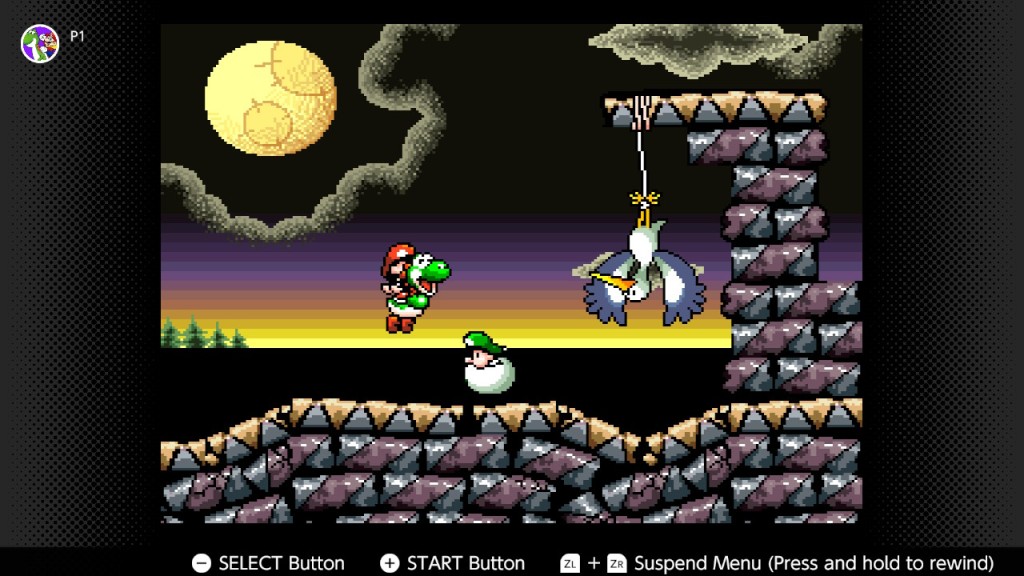
Upon booting up Yoshi’s Island, the player is greeted with a music box styled song, complete with winding sound, and a short cutscene of a stork carrying a couple babies in bindles. The stork is ambushed by Kamek on his broom. He snatches one of the babies, but the other falls to the ground, landing on the back of a Yoshi, and is revealed to be a baby Mario. The Yoshis of the island decide to help Mario reunite with his brother Luigi and the adventure starts!
The charm of the game hits the player immediately. The graphics are done in a cartoony style, with everything having thick black outlines, bright and vivid colors, and a slight crayon texture on everything–a style that Kirby’s Dream Land 3 would later adopt. All the sprites of the game are very expressive, especially the Yoshis who have a variety of frames of animations for running, jumping, throwing eggs, and everything else they do. The enemies are also lively as Shy Guys jump and dance and the giant ghost boogers hanging from the ceiling look genuinely hurt and sad when Yoshi attacks them. Adding to the whole presentation is one of the best soundtracks on the SNES. Koji Kondo expertly blends island percussion, toy instruments, and some extremely groovy bass lines to make songs that are catchy, atmospheric, triumphant, and upbeat. The completed tracking of the level select screen is one of my all time favorite video game songs and gets stuck in my head at least once a week.

Even though the full title is Super Mario World 2: Yoshi’s Island, the game is a completely different beast from Super Mario World. While Super Mario World refined Mario’s move set by giving him a few moves and powers to use in the game, Yoshi’s Island just added a bunch of gameplay features since the new playable character was a cool cartoon dinosaur. While the game is still a platformer like Super Mario World, Yoshi as a character has enough of a different move set for the game to feel completely unique.
For starters, Yoshis are either part chameleon or part frog since they can grab enemies with their long tongues and pull them back into their mouths to be spit out as projectiles or swallowed and turned into eggs. Throwing these eggs to hit distant enemies, collect coins or flowers, and hit question mark clouds to create new platforms is the biggest new gameplay mechanic to Yoshi’s Island. Making sure you are well stocked with eggs is always something to consider when running through levels since some sections may require a minimum number to use to make progress or discover a secret. Yoshi’s Island also adds a flutter jump for platforming. If you hold down the button after jumping, Yoshi does a sort of kicking motion, straining to get higher in a way that can only be described as them doing their best. While this flutter jump offers slightly more height at the end of a jump, it works best as a sort of extender to jump further or better position yourself midair. This is extremely useful because Mario must be a chonky baby since Yoshi drops like stone when falling out of a jump. It’s strange since the start of a jump and the flutter feels very floaty, but once it’s over, all momentum is lost and Yoshi just plummets. It’s something you get used to, but it did lead to falling into pits more often than it should have.
Yoshi’s Island also expands on the idea of power-ups from the Mario series. Yoshi can eat a few different watermelons throughout the game that gives them different breath powers from ice to fire to just spitting out the seeds rapid fire like a gatling gun. Besides these, Yoshi can also transform into a variety of different forms like a car, mole, submarine, or helicopter. I’m not a big fan of these sections since none of these forms control as tightly as just playing as Yoshi, especially the sub and helicopter which feel way too loose. Even baby Mario gets some play time during the adventure. Grabbing a star turns him into super baby Mario, where he is completely invincible and can over spikes and up walls. These sections are fun because they are all about going fast enough to get to the next star before the power up wears off.

The gameplay is solid, typical for a Nintendo developed platforming, and likewise there is also a huge amount of creativity on display in Yoshi’s Island. While all levels have aspects of platforming, there are still different types of levels in the game. Sometimes they’re the basic get to the end, sometimes they’re a winding maze that must be navigating, and sometimes still they’re more puzzle focused, requiring you to find keys to unlock doors. The levels’ themes are about as varied as they can be with the game being set on a sole island. The real creativity is found in the boss fights, which all differ greatly from each other and focus on different aspects of gameplay to defeat. From throwing eggs at a turtle to knock them on their back in order to attack to running around a tiny moon fighting a bird to knocking a flower pot off a ledge to exorcise the ghost inside to playing a game of break out in order to make a boss fall into lava, the bosses are a highlight of the game that consistently challenge the player in new ways. The fact that all bosses are just regular enemies that Kamek enlarged just adds so much charm to the game. Not all levels are great, but they are always interesting to play through to set what new ideas will pop up. That’s why it’s such a shame that I will never see all of them in the game.
Yoshi’s Island is a game built for completionists. Every level has three objectives in them besides just living and making it to the end: collect twenty red coins, grab the five happy flowers, and end the level with thirty star points. At the end of a level, you are scored on how much you collected and you need a score of one hundred on all eight levels in a world to unlock bonus levels. While collecting the red coins and flowers isn’t too bad, it is still tedious and bogs down the pace of the game to scouring the entire level to find them. The real annoyance comes with ending the level with thirty star points. See, these basically work as Yoshi’s life, but really they are a timer. If you get hit in a level, Mario will fly of Yoshi’s back, float around in bubble, and cry until he is caught–and I know a lot of hatred is directed at baby Mario because of the crying and, while it can be annoying, I don’t find it that terrible and see it as a good incentive not to get hit. Anyways, the star points are the amount of time you have to collect Mario before Kamek’s minions come down and spirit him away. This system seems weirdly punishing to the player, especially on levels with bosses, since it requires close to perfect play. I would make a bigger deal of it if great perfect scores in levels were required to progress through the game, but since they are only needed to unlock bonus levels, I find it fine.
Overall, Yoshi’s Island is still a great game and a worthy sequel to Super Mario World–the objective best 2D Mario game. It is so charming and filled with creativity that I think anyone can pick it up and enjoy it. It’s a perfect example of the easy to learn, hard to master mentality since unlocking the bonus levels takes time and patience to do. But even without them, there are loads of levels to play, enemies to beat, charm to be found, and memories to be made.






 Atomic Bob-Omb