Yoshi’s Island – Critical Miss #37

No Yoshi is an Island

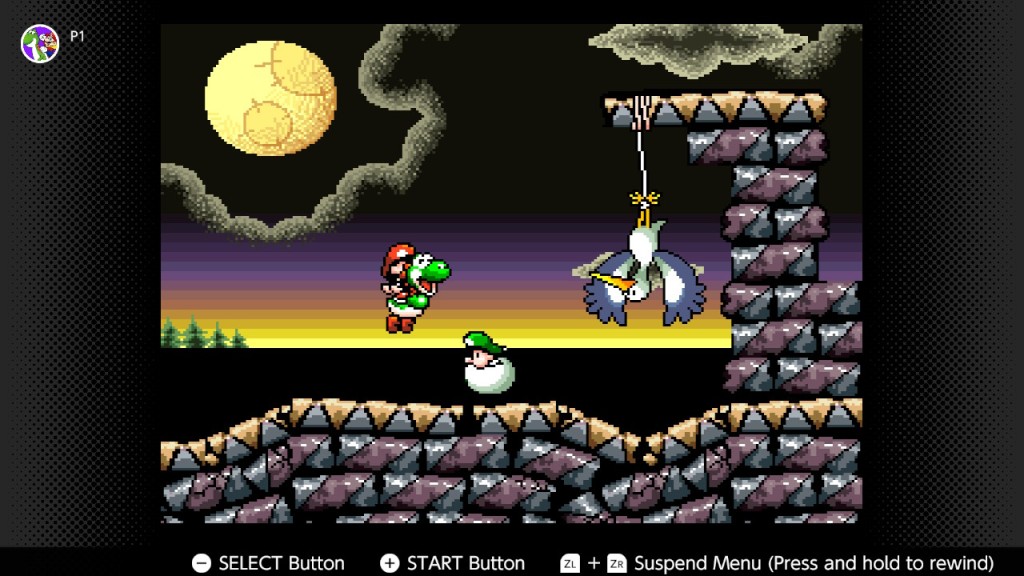
Is it just me or is anyone sad that the idea of a “virtual console” seems to be dead and buried? It seems like the halcyon days of the 7th generation digital game markets with the likes of the Playstation Network and the Xbox Live Arcade forgotten relics. Even Nintendo–who jumped started the trend and coined the term with their online marketplace, the Virtual Console–seems to be struggle with giving gamers their past legacy titles now that studios have seen how much money is to be made by carving their titles into serfdoms and releasing them as separate packages. I found myself about this as I used the Nintendo Switch Online to play Yoshi’s Island. 

Upon booting up Yoshi’s Island, the player is greeted with a music box styled song, complete with winding sound, and a short cutscene of a stork carrying a couple babies in bindles. The stork is ambushed by Kamek on his broom. He snatches one of the babies, but the other falls to the ground, landing on the back of a Yoshi, and is revealed to be a baby Mario. The Yoshis of the island decide to help Mario reunite with his brother Luigi and the adventure starts!

The charm of the game hits the player immediately. The graphics are done in a cartoony style, with everything having thick black outlines, bright and vivid colors, and a slight crayon texture on everything–a style that Kirby’s Dream Land 3 would later adopt. All the sprites of the game are very expressive, especially the Yoshis who have a variety of frames of animations for running, jumping, throwing eggs, and everything else they do. The enemies are also lively as Shy Guys jump and dance and the giant ghost boogers hanging from the ceiling look genuinely hurt and sad when Yoshi attacks them. Adding to the whole presentation is one of the best soundtracks on the SNES. Koji Kondo expertly blends island percussion, toy instruments, and some extremely groovy bass lines to make songs that are catchy, atmospheric, triumphant, and upbeat. The completed tracking of the level select screen is one of my all time favorite video game songs and gets stuck in my head at least once a week.

Even though the full title is Super Mario World 2: Yoshi’s Island, the game is a completely different beast from Super Mario World. While Super Mario World refined Mario’s move set by giving him a few moves and powers to use in the game, Yoshi’s Island just added a bunch of gameplay features since the new playable character was a cool cartoon dinosaur. While the game is still a platformer like Super Mario World, Yoshi as a character has enough of a different move set for the game to feel completely unique.

For starters, Yoshis are either part chameleon or part frog since they can grab enemies with their long tongues and pull them back into their mouths to be spit out as projectiles or swallowed and turned into eggs. Throwing these eggs to hit distant enemies, collect coins or flowers, and hit question mark clouds to create new platforms is the biggest new gameplay mechanic to Yoshi’s Island. Making sure you are well stocked with eggs is always something to consider when running through levels since some sections may require a minimum number to use to make progress or discover a secret. Yoshi’s Island also adds a flutter jump for platforming. If you hold down the button after jumping, Yoshi does a sort of kicking motion, straining to get higher in a way that can only be described as them doing their best. While this flutter jump offers slightly more height at the end of a jump, it works best as a sort of extender to jump further or better position yourself midair. This is extremely useful because Mario must be a chonky baby since Yoshi drops like stone when falling out of a jump. It’s strange since the start of a jump and the flutter feels very floaty, but once it’s over, all momentum is lost and Yoshi just plummets. It’s something you get used to, but it did lead to falling into pits more often than it should have.

Yoshi’s Island also expands on the idea of power-ups from the Mario series. Yoshi can eat a few different watermelons throughout the game that gives them different breath powers from ice to fire to just spitting out the seeds rapid fire like a gatling gun. Besides these, Yoshi can also transform into a variety of different forms like a car, mole, submarine, or helicopter. I’m not a big fan of these sections since none of these forms control as tightly as just playing as Yoshi, especially the sub and helicopter which feel way too loose. Even baby Mario gets some play time during the adventure. Grabbing a star turns him into super baby Mario, where he is completely invincible and can over spikes and up walls. These sections are fun because they are all about going fast enough to get to the next star before the power up wears off.

The gameplay is solid, typical for a Nintendo developed platforming, and likewise there is also a huge amount of creativity on display in Yoshi’s Island. While all levels have aspects of platforming, there are still different types of levels in the game. Sometimes they’re the basic get to the end, sometimes they’re a winding maze that must be navigating, and sometimes still they’re more puzzle focused, requiring you to find keys to unlock doors. The levels’ themes are about as varied as they can be with the game being set on a sole island. The real creativity is found in the boss fights, which all differ greatly from each other and focus on different aspects of gameplay to defeat. From throwing eggs at a turtle to knock them on their back in order to attack to running around a tiny moon fighting a bird to knocking a flower pot off a ledge to exorcise the ghost inside to playing a game of break out in order to make a boss fall into lava, the bosses are a highlight of the game that consistently challenge the player in new ways. The fact that all bosses are just regular enemies that Kamek enlarged just adds so much charm to the game. Not all levels are great, but they are always interesting to play through to set what new ideas will pop up. That’s why it’s such a shame that I will never see all of them in the game.

Yoshi’s Island is a game built for completionists. Every level has three objectives in them besides just living and making it to the end: collect twenty red coins, grab the five happy flowers, and end the level with thirty star points. At the end of a level, you are scored on how much you collected and you need a score of one hundred on all eight levels in a world to unlock bonus levels. While collecting the red coins and flowers isn’t too bad, it is still tedious and bogs down the pace of the game to scouring the entire level to find them. The real annoyance comes with ending the level with thirty star points. See, these basically work as Yoshi’s life, but really they are a timer. If you get hit in a level, Mario will fly of Yoshi’s back, float around in bubble, and cry until he is caught–and I know a lot of hatred is directed at baby Mario because of the crying and, while it can be annoying, I don’t find it that terrible and see it as a good incentive not to get hit. Anyways, the star points are the amount of time you have to collect Mario before Kamek’s minions come down and spirit him away. This system seems weirdly punishing to the player, especially on levels with bosses, since it requires close to perfect play. I would make a bigger deal of it if great perfect scores in levels were required to progress through the game, but since they are only needed to unlock bonus levels, I find it fine. 

Overall, Yoshi’s Island is still a great game and a worthy sequel to Super Mario World–the objective best 2D Mario game. It is so charming and filled with creativity that I think anyone can pick it up and enjoy it. It’s a perfect example of the easy to learn, hard to master mentality since unlocking the bonus levels takes time and patience to do. But even without them, there are loads of levels to play, enemies to beat, charm to be found, and memories to be made. 
Chrono Trigger & Techs

Image by Notmyhandle. Found at strategywiki.org/wiki/Chrono_Trigger

I’ve been on a strange Akira Toriyama kick lately. I’ve been watching a lot of Dragon Ball Super, which is pretty good, and replaying Chrono Trigger, which is incredible. Toriyama created all the designs for the characters and monsters in the game, and I found myself wanting to play it again while I watched DBS. I bought the DS version of the game around 2014-15, soon after I bought my 3DS and was just getting back into video games. I thought the game was amazing, but I haven’t played it since that first playthrough over a decade ago. So I picked up Chrono Trigger once again to see why it’s still so lauded as one of the best games ever made. And, honestly, there are a lot of reasons–the charming characters and surprising well written and realized story for a SNES game, the incredible soundtrack and chunky, satisfying sound effects, and the unique, engaging battle system that forces players to think on their feet. To me, it was this battle system that drew my attention most in my recent playthrough, especially the tech mechanic. The closer I looked at these techs in the game, the more I realized how much of the rest of the game was designed around them.

The techs in Chrono Trigger are the character’s special abilities. These range from strong attacks, buffs and party heals, and magic attacks that can exploit elemental weaknesses. These add a huge amount of variety to a playthrough of Chrono Trigger. Each of the seven characters can learn eight individual techs (for a total of 56), each character combination have three double techs they can perform (for a total of 45), and there a total of fifteen triple techs, ten with Chrono and five that can be performed without Chrono but instead requiring special gems that have to be equipped. This means there are a total of 116 techs in all that can be unlocked and used in the game. It’s always exciting and fun to unlock new techs and try them out. However, more interesting than the vast variety the techs bring to the games, is how these mechanics affect the design of the gameplay, both in and out of battle.

Each tech has a certain attack pattern. Whether it’s a magic spell that can hit one or all enemies, a spinning sword swing that can hit a group of bad guys in a certain proximity to each other, or Frog flying through the air and dropping bombs along a line of monsters, learning what shapes attacks take and utilizing them effectively is the key to winning in battle. Chrono Trigger places emphasis on patience during fights. Since the game uses an active battle system, enemies will wander around when not using an attack. Knowing when best to use techs that hit in a certain pattern of enemies is important to gain the upper hand. This adds a risk/reward element to fights when you consider whether it is better to attack immediately or wait for the enemies to get into a better position where you might be able to hit multiple at once.

Image by Notmyhandle. Found at strategywiki.org/wiki/Chrono_Trigger

Another addition to the risk/reward dynamic of battles in Chrono Trigger is the fact that techs can be combined. When two or three party members fight alongside each other, they can perform a combo tech, where they each perform a certain attack or spell together. This encourages experimentation with your party composition since different characters combine their techs in different ways. Lucca can set Chrono’s sword on fire for a devastating attack, Marle can create an iceberg for Ayla to throw at an enemy for massive damage, or Frog and Robo can use their healing techs together to provide a huge amount of health back to the whole party. Since each character has a different speed stat that dictates how fast their battle meter fills up, you get a similar situation with waiting for enemies to get into a good position. Is it better to wait for two party members to be ready to use a combo tech, or is it better to do damage or heal now? These considerations help the battles in Chrono Trigger feel very strategic, but still fast paced since the enemies won’t stop attacking you while you think of your next move. 

At the end of a battle, the party will receive some experience to gain levels and some Tech Points (TP) to gain new techs. While party members that do not take place in the battle will still gain exp, they will not gain any of the TPs. This is the game’s way of encouraging the player to switch up their party members to gain all the different techs and their combinations. The game is designed around having the player switch up their party in a few interesting ways. First is how the story is told. Each of the party members have unique personalities and ways of speaking, so they will comment on events in the story in different ways. This can add a little variety to a game and keeps it from going stale during repeat playthroughs.

Image by Notmyhandle. Found at strategywiki.org/wiki/Chrono_Trigger

Next is that the game never requires the player to grind, allowing players to switch around their team without having to stop and get the new member up to level. During my last playthrough, I switched party members every time they learned a new tech for someone who was closest to learning their next one. Due to this constant switching, I unlocked every tech and combination in the game with ease. I would face off with bosses using whatever team I was running at the time, and while some were definitely tougher than others, none felt insurmountable. That’s one of the most admirable things I find about Chrono Trigger, bosses require the player to think up better strategies than grind up some more levels when against a tough fight. 

Switching around characters at a consistent pace will also ensure you almost always have a new tech or combo to try out. And you will want to try them out too because they all look and sound so cool. Trying out all the combos will also help you understand what all the characters true potentials are and lead to a deeper appreciation for them. During my first playthrough of Chrono Trigger, I hardly ever used Ayla because I didn’t like that she couldn’t learn magic. During this recent playthrough, however, she was in my party more than anyone since her combo techs can deal some of the highest damage in the game. Likewise, I used Robo more during this playthrough once I learned his Heal Beam tech can be combined with most of the other characters’ healing spells for full party effect. In the end, I excluded Chrono from my party all together and fought Lavos with Frog, Marle, and Ayla as my party.

Chrono Trigger has the best problem an RPG can ever have and that is not knowing who should be in your party because you want to use all the characters. It’s another strength of the game that I didn’t appreciate until I played through ago with the intention of unlocking all the techs. It’s an amazing game that tells a compelling story and has an engaging battle system with the use of the Tech mechanic. I could honestly write many more posts about different aspects of the game and how well done they are, but I wanted to focus on techs because they are so foundation to the game’s design, both in and out of combat. I implore you to pick up Chrono Trigger if you haven’t. And if you have already, I implore you to pick it up again.

The Legend of Zelda: A Link to the Past – Critical Miss #21

Enter the Master Sword

This Critical Miss is a bit of cheat because I have played The Legend of Zelda: A Link to the Past before. As a kid, I had the Gameboy Advance rerelease of the game. From what I can tell, it’s the exact same game as the 1992 Super Nintendo game, but with a little screen crunch and more washed out colors. I wanted to play it again for this post though because I never actually finished it. When I was younger, I never made it past the Ice Temple and the few times I’ve picked it up since, I never made it much further than the beginning of the Dark World. 

The story is the standard Zelda story: evil being is being evil, find three of something to get the Master Sword to defeat them, things go wrong shortly after gaining the blade, explore more dungeons to collect more items to stop the evil once and for all. It is the same story as any other Zelda game but this time the evil being is the wizard Agahnim, who is actually Ganon in disguise, and he is collecting maidens to open up the Golden Land. Once Link has the Master Sword and defeats Agahnim, he is transported to the Dark World, the Golden Land that has been twisted and corrupted by the wizard’s evil desires.

The story is serviceable but I never found it engaging. The backstory of the Triforce and the Golden Land is mostly told by the maidens after saving them from dungeons. The story is simply told in long text dumps that are not particularly well written or interesting. The reason for the simple style of storytelling is most likely due to the limitations of the SNES, but games like Chrono Trigger managed to tell epic and engaging stories with the same limitations. 

Gameplay has always fared better on the SNES and A Link to the Past’s gameplay is still very fun. The core loop is exploration, fighting enemies along the way, and looking for gear, upgrades, and items gives a great sense of adventure. The overworld is fairly large for a SNES game and it is colorful, has varied locations from deserts to lakes to tall mountains, and is absolutely full of secrets to find. Being transported to the Dark World is a cool moment the first time it happens, but visually, it is not as appealing to look at as the Light World. It’s just kind of drab, filled with mostly browns and yellow, sick looking greens and muted purples. Thematically it is fitting, but after the bright and stunning colors of the main overworld, the muted color pallet of the Dark World gets boring after a while.

The exploration aspect of A Link to the Past is the strongest part of the game for me. Secrets like heart pieces, piles of rupees, and items are scattered everywhere across the map. It’s the type of game where you can spend hours exploring the world in between the critical path dungeons, looking under every rock and bush for hidden passages or items. Some of the most satisfying secrets to find are those that require moving between the Light and Dark Worlds because some areas, like ledges, cannot be accessed unless shifting between the two different maps. Link can teleport back into Hyrule by using the magic mirror and doing so will leave a cloud of magic dust that takes you back to the Dark World. Besides the dust created by the magic mirror, Link can only travel from the Hyrule to the Dark World by finding magic portals. It’s an interesting limitation that makes entering the Dark World a puzzle in and of itself and is used consistently to unlock areas of the map and to discover the entrances to dungeons.

Dungeons are a staple of every Zelda game and utilize a blend exploration, combat, and puzzle solving to complete. They need to be explored thoroughly to find the big key, the item needed to finish, and the lair of the boss at the end. Some dungeons require items found in the overworld to navigate, like the Swamp Palace needing the Zora flippers to swim through the changing water levels. This is great because it requires players to explore the overworld thoroughly. Typically, you will have what you need already to explore a dungeon, but if not, it’s just a matter of finding the item needed in the world. 

The items found in dungeons are often needed to defeat the boss at the end, but not always. For example, you need the magic hammer in the Dark Palace to break the Helmasaur King’s armor before you can damage him. Requiring the items found in the dungeons to defeat the boss is a design choice Nintendo would make more in later Zelda games, but in A Link to the Past most items seem to be designed with exploration and puzzle solving in mind rather than combat. This is not a bad thing, but it does make some of the items feel less impactful, like the cape, if they are only really required to gather a heart piece. This does lead to some odd choices when items in dungeons are optional. I found it very strange that Link finds the blue mail, which reduces damage taken, in the Ice Palace, only to find the red mail, which reduces more damage, three dungeons later in Ganon’s Tower. 

This is, of course, if you are doing the dungeons in the order the game suggests. They can be completed out of order, but many require items from previous dungeons to compete or even unlock the area of the map they are in. I went through the dungeons in the order found on the game map because doing them out of order seemed  frustrating to me as someone who does not know the game like the back of my hand.

The dungeons are fun for the most part because they rely so heavily on the best aspects of A Link to the Past: exploration and collecting items. That being said, however, they can get tedious to do. I think 3D gaming worked wonders on the Zelda series’ puzzle design. It added a much needed sense of spatial reasoning to explore dungeons. In the 2D games, so many of the puzzles rely on killing all the enemies in the room, pushing a certain block, or finding a button underneath a pot in order to unlock the door or make a key appear. While every dungeon has its own gimmick, the Swamp Palace’s changing water levels or Turtle Rock’s floating platform to ride, they tend to lack individual personalities to me. They have slightly different atmospheres and looks to them, but the dungeons still often look and feel too similar for my taste. 

But the game is still great, solidly designed and with a sense of adventure unparalleled by most other SNES games. It was so realized that it became the foundation for pretty much every Zelda to come after it. It introduced the collection to Master Sword to more collection outline common in other games in the series. It was the induction to staple items like the bottles, hookshot, heart pieces, and even the Master Sword itself, as well as abilities like the spin attack. It is the game that made the Zelda series what we think of today while managing to maintain its own identity since it is still a 2D game where most games that came after are 3D.

I think it’s time to admit to myself that I’m just not a huge Zelda fan. I am still a fan, but a casual one as opposed to a die-hard one. I’ve played many games in the series and, while I have enjoyed all of them, I’ve never really fallen in love with any. There’s never anything deal breaking in them that makes me shut them off, but there’s not much I can think back on that I absolutely adored. That is except the wall merging mechanic in A Link Between Worlds. I found that to be a truly genius additional that opened up puzzle and level design to a possibility not seen before in the series. And that game owes everything to A Link to the Past. It is basically its child with how much DNA it shares with A Link to the Past by being a reimagining of the game. If I had to choose a favorite Zelda game, A Link Between Worlds would be high up, probably even the top spot. So even if I did not find A Link to the Past the most engaging game to play nowadays, I will also thank it for helping create one of my favorite games in the series.

Super Metroid – Critical Miss #15

Lost in Space

Getting lost in a video game is quite the balancing act for designers of adventure games. If a game is too linear, it can feel stifling and corridor-like, but if a game is too open, it can feel directionless and obtuse. Some game genres thrive on letting the players get lost and figure things out for themselves, mostly notably sandbox games and Metroidvanias. The term Metroidvania came to be after the release of Castlevania: Symphony of the Night, which had a world design and map strikingly similar to the Metroid series, especially the third game, Super Metroid, released in 1994. I enjoy the Metroidvania genre but had never actually played a Metroid game before. So to cut my teeth on the series, I decided to play the SNES classic.

A Metroidvania survives on the strength of its exploration and Super Metroid’s world seems deceptively small at first. When you find a map terminal, it only reveals a small portion of the surrounding area. It’s only after exploring the rooms, poking and bombing around for secret holes in the walls, that you see the true expanse of the map. The levels expand out like a spider web with hallways, vertical shafts, and rooms connecting and weaving together. The world is sectioned off into distinct biomes and interconnect throughout the game. With power-ups and missile increases hiding everywhere, you are incentivized to search every nook and cranny of the map.

Many of the power ups you’ll find often aid with the exploration. The high jump boots and space jump let you reach higher ground then before, the grapple beam lets you grab onto and swing from certain blocks scattered around the planet, and the ice beam lets you freeze enemies, turning them into platforms. Missiles and bombs work as a means to open up certain colored doors for progression. I’ve always preferred how Castlevania: Symphony of the Night and Hollow Knight upgrades were changes in movement abilities like double jumps, wall jumps, and dashes. These allow the game world to feel more real, like a place that might actually exist, as opposed to something constructed solely to block passage until the right upgrade is found. Obviously, the upgrades don’t change the fact that the game is constructed and might block the player in order to guide them, but later games like Hollow Knight hide that fact much better than Super Metroid with its more organic exploration.

With constant exploration, you should be finding power ups at a very consistent rate and it does work to give the player a sense of growth throughout the game. Watching your health or max missiles increase helps the player feel better suited for the increasing challenge of the game; it empowers them. The game is great about helping the player figure out what a new power up does immediately after acquiring it. If it’s a movement ability like the grapple beam, it will be found in a room where you must use it to get out, and this lets the player think back on all the other areas it can be used. If it’s a weapon like the plasma beam, there are typically enemies you must get past that are much easier to kill with the new weapon.

It is on these small scales, the rooms with power-up designed to teach the player their uses, where the level design of Super Metroid is genius. With the minor annoyance of progress being locked behind boring colored doors, the world crafted in the beginning of the game is spectacular. The game does a lot to lead the player. Signposting boss entrances with monster heads and important areas with interesting landmarks helps the player remember parts of the map to return to later. The game actually feels rather linear in the beginning, where there is usually only one way to go without hitting a dead end. But Metroidvania games need to be open and the game soon flings wide open when you have acquired the high jump boots, ice beam, and super bombs. Sadly, as the game world becomes more open and explorable, I feel it also starts to collapse under its own weight. There is one moment in the game I can point to when this feeling cemented itself in my head and that’s when you acquire the X-ray scope.

With the X-ray scope, you have the power to shine a light on any surface of the game and reveal its secrets. Destructible blocks, hidden passages, missile upgrades and health tanks, you can now find them easily. This leads to the main area explored after finding the scope, Maridia, being plagued by seemingly dead ends and secret passages that either need to be found with X-ray scope or by blasting every tile with every weapon you have. The later part of the game feels like the developers either came up with the idea for the X-ray scope and felt justified hiding all progression from the player because they have the tool to find it, or that they built the levels with too many hidden passages and added the scope so it wouldn’t feel unfair. Either way, it doesn’t work because the X-ray scope is just too slow to use constantly. The game pauses around you while you use it and you can move with it activated, but the beam is slow and finnicking to direct. I’m sure it was the best they could do with the SNES hardware and controller, but it kills the pace. It’s a shame too because Super Metroid is a very fast paced game when you get into it.

And I did get into the game. Even while all my frustrations were mounting with the game as it went on, I wanted to keep playing. I found it very hard to put down because it was so satisfying and immersive. Part of it was due to my love of 16-bit games, but mostly I kept playing because Super Metroid has some of the best atmosphere on the SNES.

It’s hard to find a 16 bit game that is truly immersive, that makes you feel like you are in the world displayed on the screen, but Super Metroid accomplishes it with atmosphere, through incredible sound design and pixel art. One of the first things I noticed when turning on the game, is the sound effects all sounding muffled. Samus’s footsteps, her blaster, the cries of enemies, they are all slightly dampened, like they are being heard through a helmet. Explosions are crunchy, but soft, as if you were hearing them with Samus’s ears through the metal of her power suit. The world you explore is always interesting to look at. While Super Metroid doesn’t have the best pixel art I’ve seen on the system, the different biomes are lovely rendered with fitting color palettes and interesting backgrounds.The boss sprites are large and intimidating. The whole thing helps the player feel completely isolated in the game.

The atmosphere of Super Metroid is one of loneliness and bleakness. You truly feel that you are in Samus’s shoe, fighting for her life. You feel her anxiety when exploring an unknown area and her triumph when defeating a tough boss. I think that is why Samus, despite being a silent character in a relatively small number of games, is so beloved. People praise her for her bravery and for being “badass,” but she has no real character. Mario has more character than she does. I think that players projected onto her. It’s not that she is brave, you are. She’s not the badass, you are. But this gets confused in the mind because of the level of immersion the game offers the player, where they are not playing as Samus, they are her. The fact that Super Metroid, a 25 year old game from the SNES, can offer that kind of emotional experience is incredible. 

Mega Man X & Level Interconnectivity

I first played Mega Man X about a year ago and I had fun with, but when I recently replayed, I had an absolute blast. It was thrilling to dash jump pass enemies and using boss weapons to dispatch of enemies enemies. It’s the type of game that warrants multiple playthroughs after the player get used to the stiff controls and learns the layout of the levels, which can be tricky the first time with obnoxious enemy placement and hazards. The game is very replayable since the levels can be competed in any order and the upgrades collected along the way will help makes certain parts easier. There is a great sense of interconnectivity between the levels, but there is one smart aspect of the design on Mega Man X that is criminally underutilized.

First, I want to discuss boss weapons. The most basic and obvious benefit of  boss weapons is that every boss is weak to a certain weapon. This has been a staple of the franchise since the very first Mega Man released on the NES in 1987. This directly guides the player, who will most likely want to go against the boss who’s weakest against the weapon they just acquired, but there are also more subtle ways these weapons incentivise players to complete levels. 

Some basic enemies throughout the levels are easier to beat with certain boss weapons. The turtles and sea dragon mini bosses in Launch Octopus’s level die in a snap with the Storm Tornado acquired from Storm Eagle and Boomer Kuwanger’s Boomerang Cutter is useful against the Hoganmer enemies whose shields will block every projectile coming from the front. This helps experienced players choose what level to play next if they have a good idea of what enemies to expect and nudges newer player to experiment with weapons to see what works best. It also works as a guide similar to how it was handled in the older NES Mega Man games where it was sometimes best move to a different level if an obstacle or enemy was too tough because there was probably a weapon or upgrade in another level that will make it much easier, like the Magnet Beam in the original Mega Man.

During my most recent playthrough, I wanted to get the Buster upgrade as early as possible. To do so, I got the helmet upgrade from Storm Eagle’s stage and then went to Flame Mammoth’s stage. It was interesting to see that the levels were set up in such a way that both the helmet upgrade to break the blocks to the Buster upgrade and the effective weapon against Flame Mammoth were found Storm Eagle’s stage. Since I started with Storm Eagle, instead of Chill Penguin as usual, I also remembered that Flame Mammoth’s level is supposed to have fire throughout the stage.

Chill Penguin’s stage is the easiest Mega Man X stage and it is also where you get the most important upgrade: the leg’s upgrade, which lets you perform a short, quick dash. This upgrade is so useful and important to the game, that the developer’s didn’t even hide it in the stage. It’s right in the open on the only route through the level. I believe that the creators of the game intended Chill Penguin to be the first stage of the ideal playthrough because it is relatively easy with one of the most simple bosses in the game to defeat, there’s an important upgrade that impossible to miss, and it even has a new feature to the series being the ride armor. Another interesting thing that happens after defeating Chill Penguin is that the rivers of fire in Flame Mammoth’s stage completely freeze over.

There are a number of ripple effects that defeating certain bosses will have on other stages in the game and they are the most interesting thing about Mega Man X. Most notably of these is when defeating Storm Eagle. The boss fight takes place on top of an airship and, after defeating the boss, the ship comes crashing down onto Spark Mandrill’s level. This cuts off the electrical currents running through the floor in the beginning of the level  but also causes blackouts later in the level that momentarily hide the bottomless pits. Another example of this would be defeating Launch Octopus and flooding a pit in Sting Cameleon’s stage, which is needed for a health upgrade. 

These changes based on boss defeats show a lot of interconnectivity between the level and not only helps to encourage replayability, but also makes the world of Mega Man X feel alive and functioning. It feels like the world exists without the player, like it’s a clock with its gears turning to keep it ticking, and that the player is actually disrupting the natural pace. It’s a very uncommon feeling for a SNES action, in my experience, and is more akin to an epic RPG like Chrono Trigger.

While these changes across levels are brilliant, they are sadly underutilized. There really aren’t that many examples of them in the game. In fact, I named the three biggest ones in this post. I would have loved to see more like if defeating Flame Mammoth caused the trees in Sting Chameleon’s level to be on fire, exposing new enemies and making the player dodge periodic stampedes of frighten robots. Or is beating Spark Mandrill electrified the ocean in Launch Octopus’s stage, making the water dangerous and creating a more standard platforming level above the surface of the sea.

Mega Man X is a game I love and is a perfect example of why sometimes leaving the player wanting more is the smart option. While the interactions between levels due the boss weapons and stage changes give the game great replayable and help it feel alive, it’s hard not to want every boss defeated to affect the overall game in some way. The effects of defeating bosses like Chill Penguin and Storm Eagle are great, but they are so few and underutilized, it leaves the player wanting more in the best way. If nothing else, this is an aspect of the first game for Capcom to expand on if they ever make Mega Man X 9. 

Earthbound – Critical Miss #2

Smiles & Tears

We had a Sega Genesis in my household growing up which means I missed out on the entirety of the Super Nintendo’s lifespan. When I started getting more into video games years later, there was a game from the Super Nintendo that always came up as one of the best games on the system. That game was Earthbound and it always intrigued me.

The game stars Ness with his three friends, Paula, Jeff, and Poo, as they travel across Eagleland to stop an all powerful evil force named Giygas, who is making the world around them act strange and hostile. Along the way, the friends will help towns solve their problems, make new friends, and unlock their latent psychic abilities. It’s a standard RPG but with the traditional fantasy setting traded for a real world setting and the swords and bows switched for baseball bats and yo-yos for weapons.

The setting is what intrigued about Earthbound from the start. It seemed so quirky and unique. Before this review, I had tried to play it a couple times, but I never managed to beat it before. Now that I have completed the game, I see that there was a reason for that.

The presentation of Earthbound is instantly inviting. Cheery, colorful graphics with simplistic sprites meets the eye and the bouncy, bizarre music meets the ear. The music especially is great. It covers so many genres and moods while maintaining a strange, sci-fi feel. It compliments the otherworldly undertones of the game.

Earthbound has a goofy feel throughout and the enemies exemplify this. A highlight of the game is reaching new areas and seeing the sprites of all the new enemies. They range from crazed hippies and multiple types of robots to googly-eyed ducks and dinosaurs. The sprites of these enemies are always bright and colorful and cartoony. Underneath all the cartoony visuals and silly dialogue, there is an undercurrent of darkness running through Earthbound. Throughout the adventure, Ness and the gang will be attacked by police officers for causing trouble in a town, dismantle a group of cultists, save a town being plagued by zombies, and the final battle with Giygas takes place on what looks like the intestines of some giant creature.

Giygas itself is the payoff to all the darkness and tension building under the game as you play. It is a Lovecraftian nightmare, a being whose power and lust for evil is said to break its own mind at the end of the game when you face it. In true cosmic horror style, Ness and the player cannot comprehend the true form of Giygas or even its attack, which are portrayed only as swirling red shapes and flashes respectively. The battle with Giygas was a highlight for me in the game, but not for the fight itself but for the character and design of Giygas. The mechanics of the battle in the final phase when the player has to keep the party healed and have Paula pray for help I found to be tedious . With each turn of this, you watch a cutscene of the prayer reaching someone you meet along the journey and them offering you their help. While these scenes are charming, they are extremely slow and just bog down the pace of the fight for me.

The pacing of Earthbound is the biggest issue in the game. The walking speed of  the party seems fine at first, but without any consistent means of speeding them up like a run button it starts to grate. The menus are slow and clunky to navigate and the battles drag on because of these menus. These small things add up to make the moment to moment gameplay feel tedious, but there are also bigger issues with pacing that quickly fatigued me towards the end of the game.

The first of these was the grinding. In honesty, it’s not absolutely necessary to grind in Earthbound, but every time you get a new party member, whether Ness is level 10 or 40, that new character starts at level one. So if you don’t want them to be smeared by enemies or want them to be useful in combat, you have to stop and level them up. This kills the pace of the story, but not as much as the structure of the game itself. Earthbound has a overarching story, but it’s more of a loose guiding thread. The structure of the game feels more like a monster of the week cartoon series where the team comes to a new area dealing with some odd problem, they solve the problem, and move on. While this structure works to some extent because the sets are usually quirky and interesting, with only passing mentions of the looming evil of Giygas, I often felt discontinued from the main plot.

Earthbound is never great at guiding the player and nudging them in the right direction. It’s not terrible in the beginning of the game, gets at little more confusing around Twoson and Threed, and gets totally obtuse starting in Fourside. Admitting this could be a mistake in my playstyle, but even when speaking to NPCs and paying attentions of the hints they dropped, I still found myself completely lost at points. The worst examples of this were the few instances where I had to enter certain areas just to leave and trigger an event or when you have to backtrack to past areas to get information on a puzzle or key item to the current section.

All this adds up to Earthbound feeling like a slog. Towards the middle of the game, when the quirkiness was starting to feel less fresh and engaging, I started feeling very fatigued of the game. I didn’t particularly dislike the game, but I wasn’t enjoying it as much as I hoped I would.

Like most games, Earthbound is a mixture of good and bad. While I truly enjoyed the setting and enemies, it wasn’t enough to combat the slower pace of the game. If you’re a fan of older RPGs and can handle a slow moving one, I say give Earthbound a try if you haven’t already, but it’s definitely not the first Super Nintendo RPG I would ever suggest.