Yoshi’s Island – Critical Miss #37

No Yoshi is an Island

Is it just me or is anyone sad that the idea of a “virtual console” seems to be dead and buried? It seems like the halcyon days of the 7th generation digital game markets with the likes of the Playstation Network and the Xbox Live Arcade forgotten relics. Even Nintendo–who jumped started the trend and coined the term with their online marketplace, the Virtual Console–seems to be struggle with giving gamers their past legacy titles now that studios have seen how much money is to be made by carving their titles into serfdoms and releasing them as separate packages. I found myself about this as I used the Nintendo Switch Online to play Yoshi’s Island. 

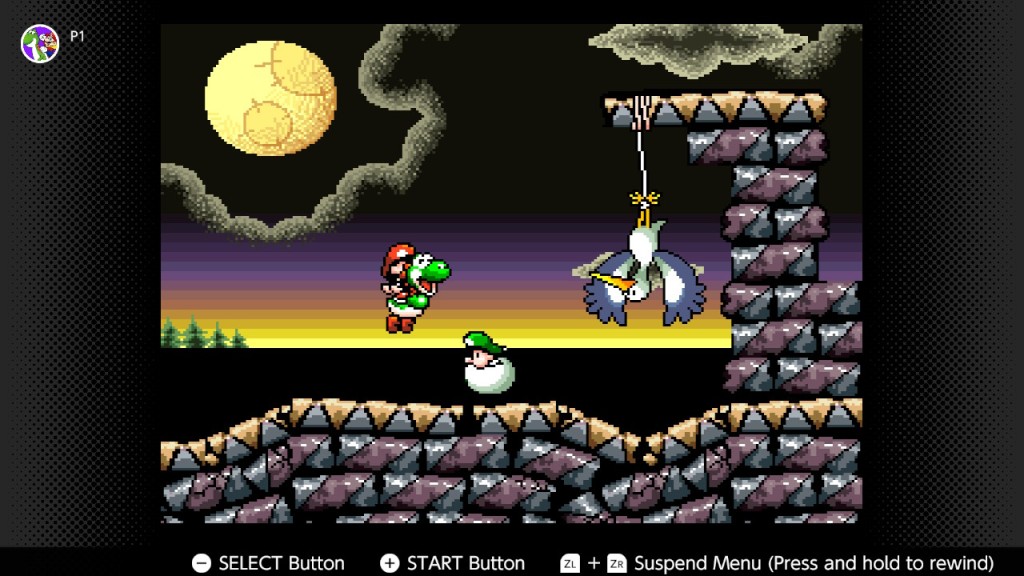
Upon booting up Yoshi’s Island, the player is greeted with a music box styled song, complete with winding sound, and a short cutscene of a stork carrying a couple babies in bindles. The stork is ambushed by Kamek on his broom. He snatches one of the babies, but the other falls to the ground, landing on the back of a Yoshi, and is revealed to be a baby Mario. The Yoshis of the island decide to help Mario reunite with his brother Luigi and the adventure starts!

The charm of the game hits the player immediately. The graphics are done in a cartoony style, with everything having thick black outlines, bright and vivid colors, and a slight crayon texture on everything–a style that Kirby’s Dream Land 3 would later adopt. All the sprites of the game are very expressive, especially the Yoshis who have a variety of frames of animations for running, jumping, throwing eggs, and everything else they do. The enemies are also lively as Shy Guys jump and dance and the giant ghost boogers hanging from the ceiling look genuinely hurt and sad when Yoshi attacks them. Adding to the whole presentation is one of the best soundtracks on the SNES. Koji Kondo expertly blends island percussion, toy instruments, and some extremely groovy bass lines to make songs that are catchy, atmospheric, triumphant, and upbeat. The completed tracking of the level select screen is one of my all time favorite video game songs and gets stuck in my head at least once a week.

Even though the full title is Super Mario World 2: Yoshi’s Island, the game is a completely different beast from Super Mario World. While Super Mario World refined Mario’s move set by giving him a few moves and powers to use in the game, Yoshi’s Island just added a bunch of gameplay features since the new playable character was a cool cartoon dinosaur. While the game is still a platformer like Super Mario World, Yoshi as a character has enough of a different move set for the game to feel completely unique.

For starters, Yoshis are either part chameleon or part frog since they can grab enemies with their long tongues and pull them back into their mouths to be spit out as projectiles or swallowed and turned into eggs. Throwing these eggs to hit distant enemies, collect coins or flowers, and hit question mark clouds to create new platforms is the biggest new gameplay mechanic to Yoshi’s Island. Making sure you are well stocked with eggs is always something to consider when running through levels since some sections may require a minimum number to use to make progress or discover a secret. Yoshi’s Island also adds a flutter jump for platforming. If you hold down the button after jumping, Yoshi does a sort of kicking motion, straining to get higher in a way that can only be described as them doing their best. While this flutter jump offers slightly more height at the end of a jump, it works best as a sort of extender to jump further or better position yourself midair. This is extremely useful because Mario must be a chonky baby since Yoshi drops like stone when falling out of a jump. It’s strange since the start of a jump and the flutter feels very floaty, but once it’s over, all momentum is lost and Yoshi just plummets. It’s something you get used to, but it did lead to falling into pits more often than it should have.

Yoshi’s Island also expands on the idea of power-ups from the Mario series. Yoshi can eat a few different watermelons throughout the game that gives them different breath powers from ice to fire to just spitting out the seeds rapid fire like a gatling gun. Besides these, Yoshi can also transform into a variety of different forms like a car, mole, submarine, or helicopter. I’m not a big fan of these sections since none of these forms control as tightly as just playing as Yoshi, especially the sub and helicopter which feel way too loose. Even baby Mario gets some play time during the adventure. Grabbing a star turns him into super baby Mario, where he is completely invincible and can over spikes and up walls. These sections are fun because they are all about going fast enough to get to the next star before the power up wears off.

The gameplay is solid, typical for a Nintendo developed platforming, and likewise there is also a huge amount of creativity on display in Yoshi’s Island. While all levels have aspects of platforming, there are still different types of levels in the game. Sometimes they’re the basic get to the end, sometimes they’re a winding maze that must be navigating, and sometimes still they’re more puzzle focused, requiring you to find keys to unlock doors. The levels’ themes are about as varied as they can be with the game being set on a sole island. The real creativity is found in the boss fights, which all differ greatly from each other and focus on different aspects of gameplay to defeat. From throwing eggs at a turtle to knock them on their back in order to attack to running around a tiny moon fighting a bird to knocking a flower pot off a ledge to exorcise the ghost inside to playing a game of break out in order to make a boss fall into lava, the bosses are a highlight of the game that consistently challenge the player in new ways. The fact that all bosses are just regular enemies that Kamek enlarged just adds so much charm to the game. Not all levels are great, but they are always interesting to play through to set what new ideas will pop up. That’s why it’s such a shame that I will never see all of them in the game.

Yoshi’s Island is a game built for completionists. Every level has three objectives in them besides just living and making it to the end: collect twenty red coins, grab the five happy flowers, and end the level with thirty star points. At the end of a level, you are scored on how much you collected and you need a score of one hundred on all eight levels in a world to unlock bonus levels. While collecting the red coins and flowers isn’t too bad, it is still tedious and bogs down the pace of the game to scouring the entire level to find them. The real annoyance comes with ending the level with thirty star points. See, these basically work as Yoshi’s life, but really they are a timer. If you get hit in a level, Mario will fly of Yoshi’s back, float around in bubble, and cry until he is caught–and I know a lot of hatred is directed at baby Mario because of the crying and, while it can be annoying, I don’t find it that terrible and see it as a good incentive not to get hit. Anyways, the star points are the amount of time you have to collect Mario before Kamek’s minions come down and spirit him away. This system seems weirdly punishing to the player, especially on levels with bosses, since it requires close to perfect play. I would make a bigger deal of it if great perfect scores in levels were required to progress through the game, but since they are only needed to unlock bonus levels, I find it fine. 

Overall, Yoshi’s Island is still a great game and a worthy sequel to Super Mario World–the objective best 2D Mario game. It is so charming and filled with creativity that I think anyone can pick it up and enjoy it. It’s a perfect example of the easy to learn, hard to master mentality since unlocking the bonus levels takes time and patience to do. But even without them, there are loads of levels to play, enemies to beat, charm to be found, and memories to be made. 
Captain Toad: Treasure Tracker & Diorama Levels

The Super Mario franchise has to have some of the most charming characters of any video game franchise. I’m not even talking about Mario, Bowser, or Peach either; characters like Boos, Wigglers, Monty Moles, and Cheep Cheeps are all beloved by me. They are all incredibly cute and show personality simply through strong character design and a few set actions. Another character I’ve grown to love is Captain Toad, but it wasn’t until recently when I played his very own game, Captain Toad: Treasure Tracker, that I saw how great the character and the world he inhabits could be. With a strong, clear focus of using dioramas as inspiration, Treasure Tracker displays not only some of the strongest level design in the Mario franchise, but some of it’s most charming.

Captain Toad as a character was introduced in Super Mario Galaxy as an adventure seeking little Toad that would appear in levels with his trademark mushroom-shaped spaceship. The same ship and character also appear periodically in Super Mario Odyssey, but in either game, the character doesn’t amount to more than a way to get an extra life or collectible. Captain Toad was first playable between those two games in Super Mario 3D World where you control the little adventurer through small, self-contained levels to collect Green Stars. While these levels were mostly just alright in 3D World, being short, easy, but ultimately fun mini interludes between the main levels, they set the foundation for Captain Toad’s gameplay and level design that was expanded greatly upon in his own game.

The levels in Captain Toad: Treasure Tracker  were inspired by dioramas and that’s exactly what they feel like—standard Mario levels that have been struck down miniature scale. They are very small and confined, but have the colorful art style, well-thought- out design, and incredible amount of polish present in larger Mario levels. The benefit of having levels so small is that they feel meticulously created. Everything in the levels is necessary—there is absolutely no wasted space in them. Aside from the critical path to the end of the level, all side paths hold secrets ranging from Golden Mushrooms for the bonus objectives to just a few invisible coins to collect. Even though the levels are tiny, they always feel rewarding to explore since the game constantly rewards the player. The levels even tend to feel larger than they actually are thanks to clever uses of the camera and level design.

Captain Toad: Treasure Tracker is played in the third person perspective, but the camera does not follow Captain Toad as he explores the level under his feet. Instead, moving the camera rotates it around the level itself, using the character as a sort of anchor, making sure the player can’t see too much above, below, or across the level from them until they reach that part. When a level starts, you can see most everything there is to see: the character rearing for adventure, the Power Star that acts as the end of the level, any and all level gimmicks or mechanics you will have to puzzle out—all the important information is present at a glance. But what the level hides in the spaces the camera can’t see immediately are the most interesting. Things like paths throughout the level, little caves to find entrance into, bonus diamonds or collectibles, pipes that take you to hidden parts of the level. These help a level feel like it’s unfolding around you as you guide the Toad throughout it and move the camera around to look into every nook and cranny present. What starts out looking like a simple, straightforward level soon balloons to a little puzzle box of branches to explore and secrets to discover.

There are over 50 levels in Treasure Tracker and—even though there are repeated level themes like grassy areas, desert ruins, little beach sides, and spooky haunted mansions—there are an abundance of level gimmicks and new mechanics being thrown at the player in every new level. This helps alleviate some of the repetition that comes from the game’s insistence on playing each level multiple times for 100% completion. The gimmicks usually revolve around moving parts of the level: wheels that rotating bridges, towers, or entire chunks of the ground, glowing blocks that can be shifted up, down, left, or right with a single touch, and some built-in mechanics like a level themed after a wind-up box that have each side of the level shifting up and down and a late game level that is just a cross of boxes the rotate around in a circle. These level gimmicks not only provide puzzles to solve and new ways to reach the Power Star, but often hide secrets within the moving parts. This is extremely common with the Pixel Toad Hide-and-Seek mode with the sneaky little Toad will be hiding behind a chunk of the level that must be moved first to see, but there are other secrets hidden within these folds of the levels. Often, if a diamond can be seen, but it is not immediately obvious how to get to it, there will be a hidden door somewhere behind a piece of shifting level. This again helps the levels feel bigger than they are due to every part of the level being used to encourage exploration.

The small, diorama levels adds another brilliant aspect to Captain Toad: Treasure Tracker, but it is the hardest aspect to explain due to its extremely subject nature. This aspect is the charm of the game. It all comes down to the art style. The highly polished and colorful style makes the game feel like a Saturday morning cartoon, especially when paired with the upbeat and catchy music. Super Mario 3D World has a similar art style, but it seems like the artists just had much more opportunity to fine-tune each and every level in Captain Toad: Treasure Tracker simply due to their smaller nature. The world in the game is just a very cheerful, pleasant, and cute one to immerse yourself in. Captain Toad and Toadette themselves also help to add to the charm of their game through the determination they show in trying to reunite with each other and the excitement they display when collecting another treasured Power Star. Each level is so enjoyable to explore and cute to see, that you will soon find yourself unable to put the game down just by sheer desire to see what comes in the next level. 

It’s telling how well the diorama inspiration aids the design and overall fun of Captain Toad when you look at the levels that stray away from that focus. Some levels, like the boss fights, mine cart levels, and levels that just feel overly large, seem to ignore the diorama structure of the others and they feel much weaker for them. These larger levels feel too long to complete—especially when trying to 100% the game requires multiple playthroughs of every level. They are not poorly designed, however, just more tedious and tiresome to complete.

Basing the levels on dioramas not only provides a clear focal point and through line throughout Captain Toad: Treasure Tracker, but also helps limit any excess commonly found in games nowadays. With keeping levels small, confined, and focused, the developers were able to make the most out of every level’s space and mechanics. Every level in the game feels so finely tuned, so meticulously crafted, and polished to a brilliant shine that it works as an example of the benefit of limiting a project’s scope, almost like a counterpoint to the massive, bloated open-world games that have taken over AAA game. Much like a diorama or miniature, if you have a very small space to create in, you better make sure it is the most detailed creation you can make.

Super Mario Galaxy: Critical Miss #25

Shoot for the Golden Stars

I’ve always loved Mario games. From the colorful, cheery art styles to the depth of the movement mechanics to the sheer creativity displayed in the games, Mario is the undisputed king of video games. But there are still major gaps in my experiences with his games. I never had a Gamecube growing up so I missed out on Sunshine and The Thousand-Year Door until recently. While I had a Wii as a teenager, I didn’t really play it all that much. This means I also missed out on Super Mario Galaxy, the debut 3D Mario game on the system released in 2007, still widely considered to be one of the best games in the series, until the recent rerelease of the game in the Super Mario 3D Allstars on the Switch. 

The core game of Galaxy appears to be untouched with its port to the Switch, but what has changed are the controls. Since the game was made to be the marquee 3D Mario title of the Wii, Galaxy was designed to be a showcase of the new Wiimote and its features. The pointer was used to collect Star Bits, grab blue stars to pull Mario to them, and sometimes even an air horn looking fan that blows Mario in a bubble. Motion controls were utilized too, of course. Wagging the Wiimote made Mario do a spin attack and specific levels, like the manta ray racing and ball rolling levels, have unique controls that all involve twisting the Wiimote around. The Switch port allows the player to substitute the motion controls for standard button and analogue stick controls, but offers the player two options for how to control the pointer. In handheld mode, you use the Switch’s touch screen to guide the pointer. In menus or simpler levels, this works fine, but in long Pull Star sections, you will find your hand blocking most of the screen, making it impossible to see what’s coming up ahead. In docked mode with detached Joy Cons, you can use the right controller to aim the pointer and this is how I would recommend playing the game. Since the Joy Con uses gyro motion instead of infrared sensors like the Wiimote, you will have to recenter the pointer often, but this is easily done with a quick press of the R button and is never a hassle.

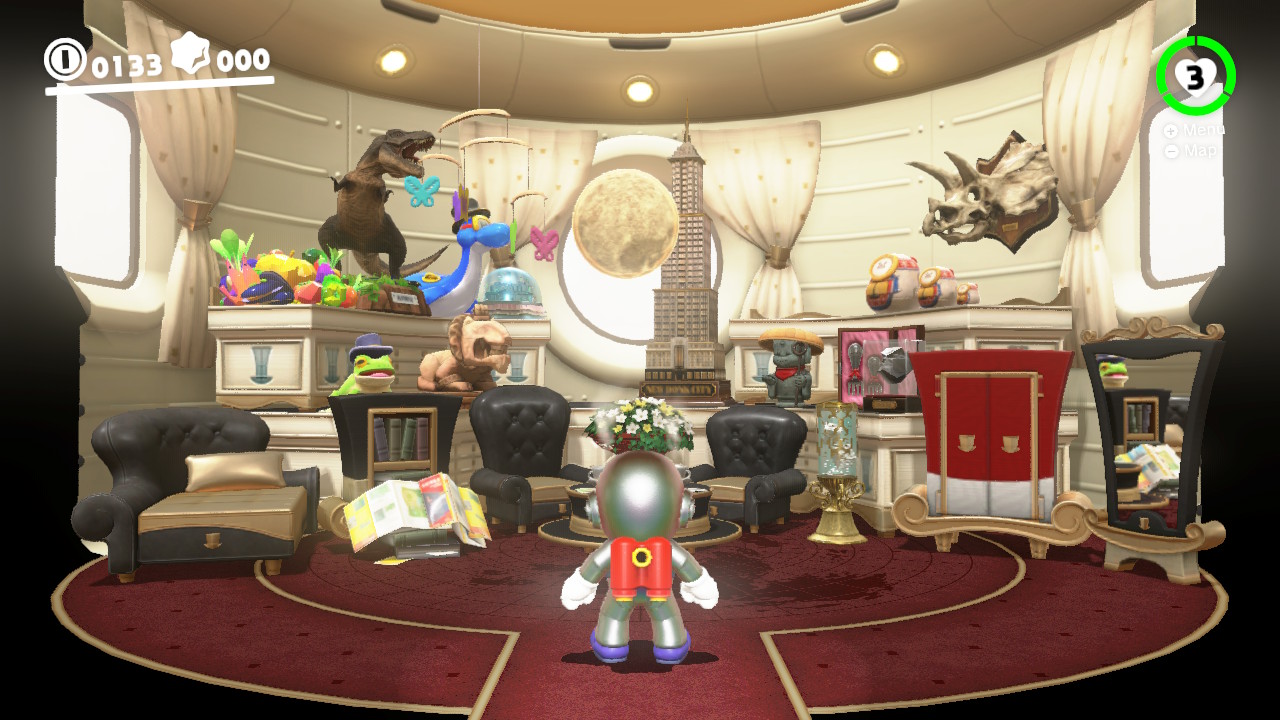
I wanted to mention the differences in controls because that’s the only major difference in the version of the game I played. Besides those, Super Mario Galaxy is the same game at its planetary core. After Bowser steals Peach along with her entire castle and a short tutorial level, Mario finds himself on the Planet Observatory, newcomer Rosalina’s intergalactic vessel. As a hub world, the Planet Observatory is not my favorite. There are nice aspects to it, like how more instruments get added to the theme that plays and the more livelier it feels as you progress through the game, and I appreciate how contained and focused it feels. However, there’s not much to do there—no secrets or extra levels to find and all rewards like extra lives are in plain sight. I think I would have preferred a simple level select or world map instead because the act of climbing all the way up the Observatory for late game levels takes a little too long, and that’s time taken out of playing the wonderful levels.

The incredible amount of creativity and variety on display in Super Mario Galaxy cannot be understated. There are forty-two levels in the game and, besides a few common themes and a few outright reskins near the end, each has mechanics and challenges differing from the rest. Sometimes you will be running under little planets as the camera tries to follow you. Other times you will be in a side scrolling type section with arrows on the walls dictating which direction gravity will pull you. There are launch star pieces to collect, blue switch pads to hit, lasers to avoid, cages to blow up with Bullet Bills, Star Bits to gather to feed to hungry Lumas for power up and additional routes in levels and even additional levels themselves! The whole game feels like you are a kid adrift in Toy Time Galaxy.

Forty-two levels is a massive increase to Mario 64’s fifteen stages and Sunshine’s nine (even Odyssey’s sixteen later), but there is the same amount of Stars to collect in all three games. This is because Galaxy’s levels are much smaller and usually more linear than the other 3D games in the series. Most levels have only three Stars to get with maybe a secret Star or Prankster Comet Star (a remixed challenge of a previous Star) to grab. This leads to the designs on the levels having a more mission based, get-to-point-B objective to them instead of 64 and Sunshine’s sandbox approach to level design. You see the Star’s location and a general route in the initial flyover of the level and then it’s just completing the challenges in the way to grab it. This would get repetitive having to do the same challenges three times, but luckily Galaxy’s levels have a lot of bits and pieces that are swapped in and out for different stars like building different things from the same set of Legos. It’s a little disappointing that players can’t decide or make their own path through levels like you can in other 3D Mario games, but with most of them being composed of small planets, with each having their own unique goal to accomplish, I understand why. The levels you create from hungry Luma’s themselves are just one-off challenges with a single Star to collect.

The whole game feels sadly limiting to the player—almost to the point where it feels more like a 2D game in the series as opposed to a 3D one. Mario has all his acrobatics of Super Mario 64 and that means a long list of moves that can be performed; the long jump, the triple long, slide somersault, and backflip are all tools like your plumber overall to pull out and use at any moment. Unfortunately, the game doesn’t give you much reason to ever use them in creative ways. I didn’t see anywhere I could take a shortcut by making tricky jumps like in 64 or Sunshine or any hard to reach nooks hiding secrets and collectables like the later 3D World and Odyssey offered. I may have missed them since it was my first time playing the game and it didn’t rather bother me that much in the end. With level design this stellar, it is not actually much of a problem that they are more linear because they are still incredibly fun to go through, but it did clash with how I expect a 3D Mario game to feel and that it was a little jarring.

The more I played Galaxy, the more it struck me how much of a transitory game between the older sandbox designed games in the series like 64 and Sunshine and the more linear 3D games of 3D Land and 3D World that took inspiration from Mario’s 2D roots. Oddly enough, this thought came to me most when thinking about the power-ups in the game. There’s a good handful of power-ups on display in Galaxy—more so than any other 3D game of the series at that point. The Fire Flower makes its debut in 3D, the Ice Flower creates ice under Mario’s feet and lets him slide across water, Bee Mario can fly for a short time and climb on certain surfaces, Spring Mario hops everywhere and is terrible, and the spooky Boo Mario can become intangible to phase through walls. All these power-ups are great fun to use, so it’s disappointing that they are as situational as the power-ups in 64 and some F.L.U.D.D. upgrades in Sunshine. Most are on a timer (including the Fire Flower which has always been an upgrade until the player was hit) and are used for specific challenges that must be completed with them. There is no way to take a power-up from the level you find it in and bring it to another for creative and experimental uses like would be possible in 3D World, there didn’t seem to be any chances to even bring them to different parts of the level to find secrets like you can with the Captures in Odyssey—you have to use them only for the specific challenge right in front of you. I get having more limited challenges help curate a more focused game, but it led to a nagging sense of inorganicness in the back of my head.

These are the things that came to my head when sitting down to write this review—the more linear, but still incredibly designed, fun, and creative levels, the disappointing situational requirements of the power-ups that had so much more potential, and the lack of utilization of Mario’s acrobatic movement, his greatest feature. But none of this is a deal break at all. Super Mario Galaxy is still an incredibly fun and rewarding game and very much deserves to be played today. I won’t say that I wasn’t disappointed with it because I was, but only slightly. After years of hearing how it’s possibly the greatest game ever, after countless reviews lauding its praises, and after playing Super Mario Odyssey—easily the best Mario game to me and possibly even one of the best games Nintendo has ever made—Galaxy had no chance other than to disappoint do to my in the clouds expectations and that is not the game’s fault. That’s the poison of hype, folks: it leaves you satisfied with even the greatest of games.

Super Mario Odyssey & Player Rewards

When I was fourteen, I got my first Nintendo DS. Along with it came a copy of Super Mario 64 DS. I didn’t know at the time that it was a port of an Nintendo 64 game, I didn’t even know what the term “port” meant in that context, nor did I care. Super Mario 64 is such a great game, it didn’t matter that it was clunkier to control with the d-pad, I fell in love with it. It was one of the first moments I can remember of realizing games can be something truly special. And, much like how they revolutionized 3D games with Super Mario 64, Nintendo would completely rewrite the script on 3D platformers again over 20 years later with Super Mario Odyssey.

Mario Odyssey is a phenomenal game. It’s easily my favorite Mario game and probably sits in my top 10 games of all time. Recently, I played through the entire game again and I was constantly reminded of how good it is, how impeccably designed, how fun to play, how satisfying it is. And it is that one aspect that piqued my interest in my last playthrough: satisfaction. A common complaint I’ve seen against Odyssey is that there are too many Moons and players can collect them so often that they lose their value and stop feeling special. I’ve never felt this way and, in fact, feel that this complaint ties directly into the main design of the game. Odyssey constantly awards players’ curiosity and exploration to give them a sense of fun and satisfaction.

There are many ways to reward players: experience points for levels, skill points for unlocks, leader boards for competitive games. Being a 3D collectathon, Super Mario Odyssey rewards players with collectibles. Be it coins, purple tokens, or Power Moons, every level of Odyssey is filled to the brim with things to grab and collect. Besides collectibles, the levels are just full of stuff in general. It has some of the most densely packed level design I’ve ever seen but, thanks to the standard Nintendo polish, the worlds you explore never feel cluttered or sloppy. 

The collectables are the main tool the designers push players to explore the levels thoroughly and challenge themselves to find everything because they are actually worth something in Odyssey. In Super Mario 64, Power Stars were collected to unlock new levels and coins are only collected to restore health and get certain Stars. While the Power Moons in Odyssey only unlock progress, similar to 64’s Stars, coins have much more importance. Along with the purple tokens, which are needed to purchase level specific souvenirs and stickers for Mario’s ship, the Odyssey, coins can be used to purchase new outfits in the shop. This is so highly incentivized that upon death, the player doesn’t lose a life, but a handful of coins. The outfits, souvenirs, and stickers don’t actually have any gameplay effects, but they are still strangely addicting to collect. They add so much charm to the game—especially the outfits which can be mixed and matched to make Mario look utterly ridiculous. 

Even the enemies work as collectibles in a way. Mario can possess certain enemies by throwing his cap onto them and there is a whole bestiary-like list of all of them in the game. When possessing an enemy, the player has access to their special abilities. This replaces the standard power ups of a Mario game, but the creativity and variety enemy possession offers is unparalleled. The first thing in the game I wanted to complete was the enemy list because they were so much fun to control. It is always exciting in the game to stumble upon a new enemy and throw your cap at it for the first time, to see what new moves it’ll have and how it will open up the world around you.

So the designers fill a level with Power Moons, coins, purple trinkets, and enemies to play with and drop the player in the middle of it. The first time in the level, there will be an objective to complete but how you get there and how long it takes is up to the player. It’s tough to go from point A to B when there is a playground of things to do, collectables to be grabbed, and fun to be had in between. The designers know this too and smartly do not discourage players from going off the critical path. In fact, they encourage it. They use collectibles to catch the player’s eye and lead them to different areas. They use landmarks in the distance to keep pushing players forward. Finally, when a player fully understands Mario’s special jumps and movement abilities, they tease players with areas that seem to be out of reach.

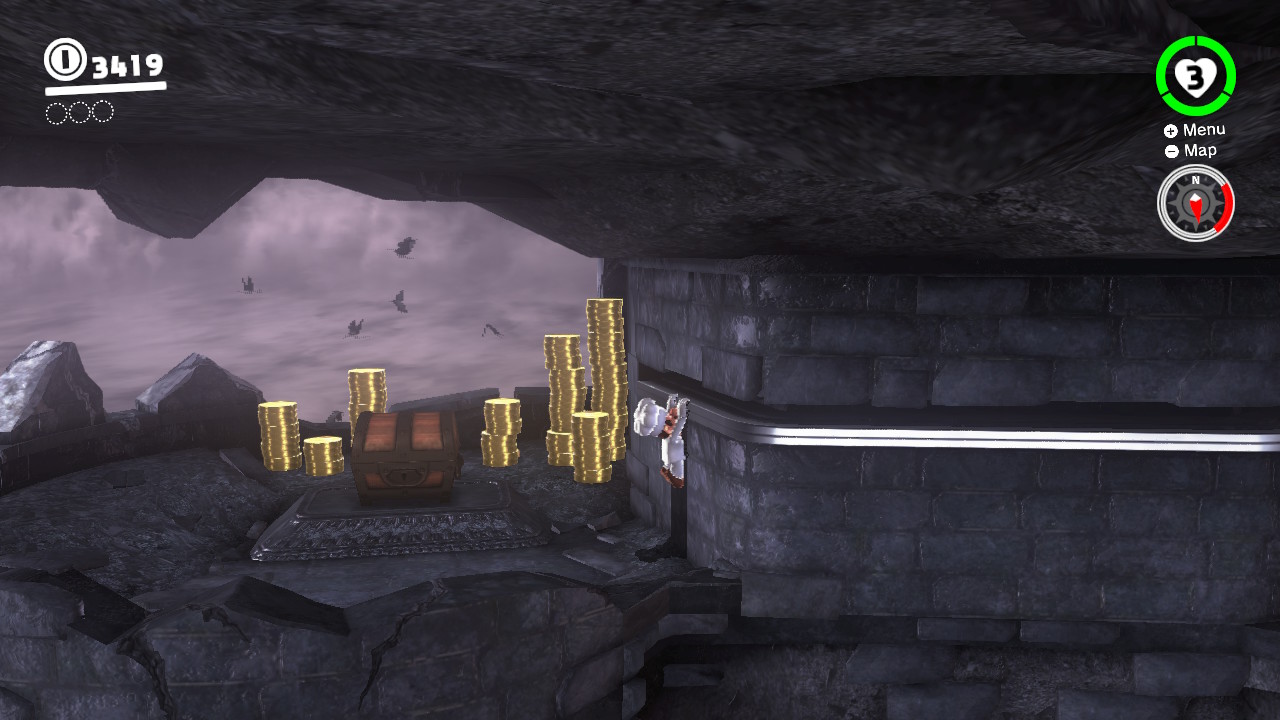
Some of the best moments in the game are when you see a ledge that is slightly too high to jump to or an area just out of reach and think to yourself ‘I can get up there.’ So after a series of wall jumps, air dives, and cap bounces, you make it some place you’re seemingly not supposed to access and there is always something there for you. Sometimes it’s a secret Power Moon, but usually it’s just coins. But that’s ok because it feels like a wink from the developer, it feels like an in-joke between you and them and they are congratulating you. There is a staggering amount of depth to the movement options in the game and it feels good to accomplish a tricky jump to an area that seems like it would have been forgotten by the developers only to be rewarded. 

Collecting these Power Moon, coins, and outfits never stops feeling satisfying. It preys on the part of the human brain that likes feeling they’ve accomplished a task, no matter how simple, the part that likes filling out checklists and seeing things tidy and complete. It’s the same part of the brain that the game industry preys upon with loot boxes and limited time character skins. But this satisfying feeling is used for good instead of evil in Super Mario Odyssey because it requires nothing from the player besides skill and patience, no additional money or microtransactions, and I believe that makes it even more satisfying. 

It’s truly amazing how Ninendo can create seminal, groundbreaking games time and time again. But it’s not really surprising when you consider the attention to detail and focus they put into their games. Nintendo’s policy has always been to put fun first and that shines clear in Super Mario Odyssey in how they constantly reward the players’ curiosity. They provide playgrounds just begging to be explored and cover them with things for the player to find so there is no moment lacking satisfaction. This is why I seriously consider Super Mario Odyssey one of the most fun games to simply play.

Paper Mario: The Thousand Year Door – Critical Miss #12

Heart & Craft

I’ve been trying to build my Gamecube collection lately, but it’s a tricky endeavor. Nintendo games tend to retain value and add the fact that the Gamecube is one of Nintendo’s lowest consoles, you have a recipe for expensive games. I was grateful when a friend borrowed we their copy of Paper Mario: The Thousand-Year Door. It had been on my list for years but the game still goes for at least $50-$70 online, for a game released in 2004. That’s full price nowadays for a game over 15 years olds. But, I must admit, after playing the game, I see why it’s still so expensive and sought-after. 

To get the obvious out of the way, the first thing that needs to be brought up when discussing any Paper Mario game is the art style. Thousand-Year Door, like other Paper Mario games, uses a paper aesthetic for the art. Characters are paper cut outs and turn on their axis when changing directions. Things like hidden stairs and bridges are often revealed by a turning page or unfolding out of a wall. I found myself wishing that the game would go further with the paper aesthetic, but it still adds a lot of charm to the game. 

By far the strongest aspect of the art style is the character designs. A lot of NPCs in the game are classic Mario enemies, but there are a ton of new character designs on display. Be it the wrestling champ Rawk Hawk, the penguin detective Pennington, or the race of Punis, all the character designs are bold and colorful and extremely charming. One character, Ms. Mowz, has become one of my favorite character designs in video games. She a little mouse femme-fatale, burgular who wears a little red mask and silhettos. She’s extremely cute and her design perfectly encapsulates her personality. 

The story of Thousand-Year Door is simple and fun. The overarching plot is Mario searching for the seven crystal stars in hopes it will lead him to Princess Peach, who has been kidnapped by the X-Nauts. In between chapters, Peach Princess interacts with a computer, TEC, who’s fallen in love with her and Browser works to catch up to Mario and claim the crystal stars for himself. The writing throughout is clever and often very funny. My favorite gag in the game is the creature hiding in black chests that curses you, but the curses all turn out to be new abilities for Mario and are very useful.

The main plot of the game usually takes a backseat to whatever adventure Mario is currently on for a crystal star. The game is split into chapters and each one is varied and unique. The first chapter is a standard RPG story as you raid an abandoned castle and fight a dragon. But soon you will be entering a wrestling league, trying to reclaim your body after being turned into a shadow, or solving mysteries on a train like it’s an Agatha Christie novel. Chapters find a good balance of combat, puzzle solving, and witty dialogue, with only a few struggling with that balance like the train section or the pirate’s cove. The game feels like it wasn’t satisfied with telling a standard, epic RPG story, but instead wanted to explore different types of storytelling in an RPG format, and it pulls it off phenomenally.

I had only one minor complaint about the game and that is some sections require too much backtracking. The levels are designed as left to right rooms, like a 2D level in 3D, and when the game asks the player to go back and forth across these areas, like on Keelhaul Key and the trek between Twilight Town and the Creepy Steeple, you soon realize how boring the sections are after you solved all the puzzles during the first go around. The worst sections of this are the train to Poshley Heights, which is literally just a five room hallway, and the search for General White, which has you going through nearly all previously visited areas in search of the old Bob-omb.

A major difference The Thousand-Year Door has from standard RPGs is the leveling system. You don’t gain random stat increases as you level up, you don’t get skill points to spend on perks, you don’t even get new armor for more defense. Instead, each time Mario defeats an enemy, they drop star points, and after collecting 100 star points, Mario levels up. As soon as he levels up, the player has a choice to increase Mario’s health, Flower Points (the game’s magic points), or his Badge Points. Attack increases come by finding new hammers or shoes to improve Mario’s basic attacks or by equipping different badges to Mario.

Throughout the game, you will find many different badges. These badges can be equipped to Mario based on how many Badge Points Mario has available and how many points each badge requires. The badges provide a multitude of benefits ranging from new attacks, stat increases like more health or defense, or passive perks like randomly dodging some attacks or decreasing the cost of special moves. This system is extremely interesting because it encourages creativity from the player and is how the games lets  players make builds or classes in the game. You can build a magic class by equipping all the badges the decrease the FP costs of special attacks, a tank by using the defence badges, a dex type class by using the badges that give you the best chances to avoid damage, or you can just mix and match all the different types of badges to whatever fits your playstyle best. 

Mario isn’t alone on his journey, of course. Throughout the game, Mario will make new finds who will join his party and adventure alongside him. These characters range from familiar Mario enemy types with personalities like Goombella the Goomba and Koops the Koopa Troopa to completely new designs like Vivian, one of the Siren Sisters, and Madame Flurrie the wind spirit. There is even a baby, punk-rock Yoshi that the player gets to name! I named my B. Idol. All the party members are rather one dimensional, but, along with their strong designs, they feel more like cartoon characters and it works well in the game. Mario’s new friends all have unique abilities to help him solve puzzles and find hidden items in the overworld: Madame Flurrie blows away loose pieces of paper, Admiral Bobbery can blow up certain walls, and Koops can spin across gaps in his shell to collect items or hit switches. 

Your party members also aide you in battle and, much like the story, the combat in Thousand-Year Door is simple, but extremely fun.  Mario only has a jump and a hammer attack along with any badge attacks you have equipped, and those attacks can only hit certain enemies. Flying enemies or enemies not in the front row are out of reach of Mario’s hammer but can be easily jumped on. Spikey or flaming enemies will hurt Mario to jump on but are vulnerable to hammer strikes. Your partners attacks work in the same way. Some attacks can only hit ground enemies in the front row, some can jump on any enemy but is dangerous against spiky enemies, and some, like Vivian’s fire, can hit any enemy. 

The combat is pretty easy throughout, but it is one of the most fun battle systems in an RPG. There is a puzzle-like mechanic of knowing which enemies can be struck by which type of attack. While in most RPGs, the player is only required to navigate menus to select an attack and watch it occur, Thousand-Year Door uses an Action Command style meaning the player must do a specific action for an attack to do more damage or be effective at all. These actions could be pressing the A button at the right time, holding the joystick to the left and releasing, the right time, entering a random string of numbers, or rapidly pressing the triggers. This keeps the battles engaging the entire length of the game because they feel like tiny minigames to focus on. Many have stated the the combat in Thousand-Year Door is too easy, and it is very easy with only the final boss being a real challenge, but I found the battle system to be too engaging and simply too much fun for it to bother me.

Paper Mario: The Thousand-Year Door is a truly excellent game and an easy recommendation to anyone. The story and art style is charming and fun for anyone to enjoy it, and the combat is easy enough for an RPG novice to play while still having the Action Commands to engage anyone with more experience in the genre. This game has quickly climbed to the top of my list I wish to be rereleased for the Switch and, based on how fans have been begging Nintendo to return the Paper Mario to the style of Thousand-Year Door and how much critical acclaim this game has rightly gotten, I don’t feel alone in wishing for it.